
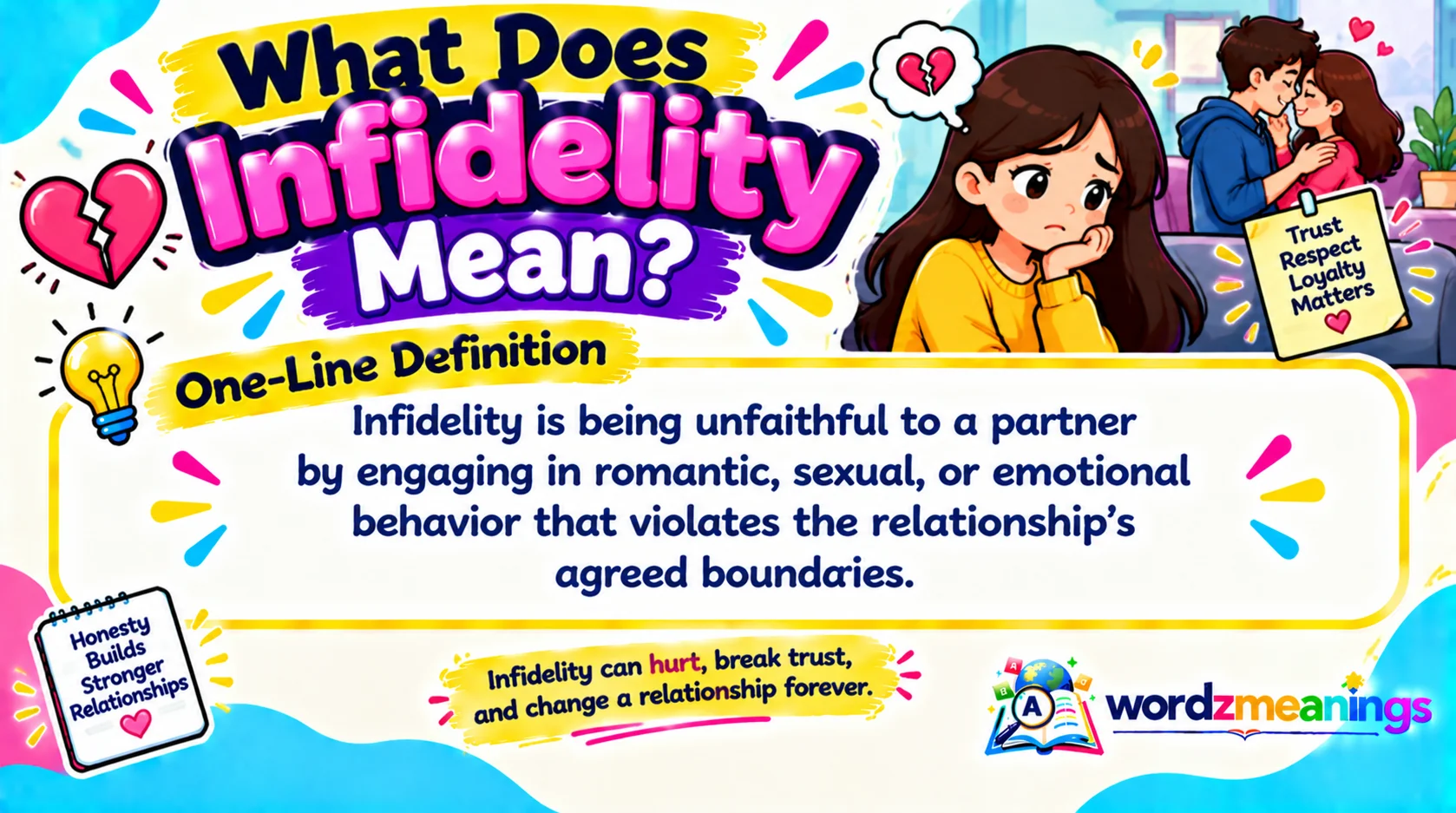
Infidelity means being unfaithful to a romantic or married partner by breaking the relationship’s agreed boundaries, often through a romantic, sexual, or emotional connection with someone else.
People usually search what does infidelity mean when they see the word in relationship discussions, news, books, movies, social media, or dating conversations.
Understanding the term matters because infidelity can mean different things in different relationships.
What one couple considers cheating may not be the same for another couple, especially when emotional relationships, online conversations, or social media are involved.
Quick Answer
Meaning
Infidelity means being unfaithful to a partner or breaking the agreed rules of a romantic relationship.
Full Form
Infidelity is not an abbreviation, so it has no full form.
Pronunciation
Infidelity: in-fuh-DEL-uh-tee
Category
Relationship term, social term, and emotional or sexual behavior.
Tone
Usually serious, negative, and sensitive.
Used On
Everyday conversations, relationship advice, dating discussions, books, movies, social media, news, and professional discussions about relationships.
Difficulty Level
Easy to understand, but its exact meaning can depend on the boundaries of a relationship.
One-Line Definition
Infidelity is being unfaithful to a partner by engaging in romantic, sexual, or emotional behavior that violates the relationship’s agreed boundaries.
What Does Infidelity Mean in Simple Words?
Simple Definition
In simple words, infidelity means cheating on a romantic partner.
For example, if someone is married or in a committed relationship and secretly starts a romantic or sexual relationship with another person, that may be called infidelity.
The word can describe many forms of unfaithfulness. It does not always mean having sex with another person. Depending on the relationship, secretly developing a deep romantic connection, sending sexual messages, or maintaining another hidden relationship may also be considered infidelity.
Easy Example
“She discovered that her husband had been having an affair.”
What Does Infidelity Mean
In Very Simple English
Infidelity = being unfaithful to your partner.
What Is the Meaning of Infidelity in a Relationship?
Infidelity and Relationships
In a relationship, infidelity usually means crossing a boundary that the partners expect each other to respect.
These boundaries can involve:
- Sexual activity
- Romantic relationships
- Emotional intimacy
- Secret dating
- Sexual messages
- Secret meetings
- Online relationships
- What Does Infidelity Mean
- Maintaining a hidden partner
The important point is that infidelity is connected to trust and relationship boundaries.
Why the Exact Meaning Can Differ
There is no single rule that defines every relationship.
For one couple, kissing another person may be considered cheating. For another couple, the boundary may focus on sexual relationships. Some couples may also consider secret romantic messaging to be a form of infidelity.
That is why context matters when deciding whether a particular action fits the term.
What Does Infidelity Mean Compared With Cheating?
Infidelity vs. Cheating
What Does Infidelity Mean
| Term | Meaning | Common Use |
|---|---|---|
| Infidelity | Being unfaithful to a romantic or married partner | More formal |
| Cheating | Breaking relationship rules by being unfaithful | More common and casual |
| Affair | A romantic or sexual relationship outside an existing relationship | Often describes an ongoing situation |
| Unfaithfulness | Failure to remain faithful to a partner | General term |
| Betrayal | Breaking someone’s trust | Broader meaning |
Which Word Is More Common?
What Does Infidelity Mean
Infidelity sounds more formal and is often used in writing, relationship discussions, counseling contexts, books, and articles.
For example:
“He cheated on his girlfriend.”
This is casual.
“The couple struggled after discovering his infidelity.”
What Does Infidelity Mean
What Are the Different Types of Infidelity?
Sexual Infidelity
Sexual infidelity usually refers to sexual activity with someone outside a committed relationship when that behavior violates the couple’s agreement.
For example:
“He had a sexual relationship with someone else while he was married.”
This is commonly described as sexual infidelity.
Emotional Infidelity
Emotional infidelity involves developing a strong romantic or intimate emotional connection with someone outside the relationship.
It may involve:
- Sharing deeply personal feelings
- Developing romantic feelings
- Secretly communicating
- Hiding the relationship from a partner
- Giving another person emotional attention normally reserved for the relationship
What Does Infidelity Mean
Physical Infidelity
Physical infidelity generally refers to physical romantic or sexual contact with someone other than one’s partner.
Examples may include:
- Kissing
- Sexual touching
- Sexual activity
- Other intimate physical behavior
The exact boundary depends on the relationship.
Online Infidelity
Online infidelity refers to unfaithful behavior that happens through the internet or digital platforms.
What Does Infidelity Mean
- Secret romantic chats
- Sexual messaging
- Sending intimate pictures
- Online dating while committed to someone else
- Developing a hidden online relationship
The fact that something happens online does not automatically make it infidelity. The relationship’s boundaries and the nature of the behavior matter.
Micro-Cheating
Micro-cheating is a newer relationship term used for small or subtle behaviors that may suggest romantic interest outside a committed relationship.
Examples sometimes include:
- Secretly flirting
- Hiding conversations
- Keeping a dating profile active
- What Does Infidelity Mean
- Concealing attraction from a partner
The term is informal, and people disagree about exactly what counts as micro-cheating.
What Does Infidelity Mean Emotionally?
Emotional Meaning
Infidelity is often associated with a loss of trust.
A partner may feel hurt when they discover that important relationship boundaries were broken. Feelings can include:
- Sadness
- Anger
- Confusion
- Disappointment
- Jealousy
- Betrayal
- Insecurity
What Does Infidelity Mean
Why Trust Matters
A committed relationship usually involves expectations about honesty and loyalty.
When someone secretly breaks those expectations, the issue may become larger than the specific action. The partner may also question what else was hidden or whether previous statements were truthful.
What Does Infidelity Mean in Marriage?
Infidelity in Marriage
In marriage, infidelity commonly refers to a spouse having a romantic or sexual relationship outside the marriage without the other spouse’s agreement.
For example:
What Does Infidelity Mean
Here, infidelity means unfaithfulness within the marriage.
Does Infidelity Always Mean an Affair?
No.
An affair often refers to an ongoing romantic or sexual relationship outside the primary relationship.
Infidelity is the broader concept of being unfaithful.
A single act can be described as infidelity, while an affair may continue over a longer period.
What Does Infidelity Mean in Dating?
Infidelity While Dating
What Does Infidelity Mean
For example, if two people clearly agree that they are exclusive and one secretly dates another person, that may be considered infidelity.
If two people are casually dating and have not agreed to exclusivity, seeing another person may not have the same meaning.
Why Exclusivity Matters
The relationship agreement is important.
Before calling something infidelity, it helps to understand:
- What type of relationship exists?
- Have the partners agreed to exclusivity?
- What boundaries have they discussed?
- Was the behavior hidden?
- Did the behavior violate an agreed expectation?
Examples of Infidelity in Everyday Situations
Example 1: Secret Affair
“Mark was married but secretly dated another woman for several months.”
Explanation:
This is a clear example of behavior commonly described as infidelity because Mark was maintaining another romantic relationship while married.
Example 2: Sexual Messages
“She discovered that her partner had been sending sexual messages to another person.”
Explanation:
This may be considered infidelity if those messages violate the couple’s agreed relationship boundaries.
Example 3: Emotional Relationship
“He became romantically attached to someone else and hid their relationship from his wife.”
Explanation:
This may be described as emotional infidelity because the behavior involves a hidden romantic or emotional connection.
Example 4: Dating App
“She found out that her boyfriend was secretly using a dating app to meet other people.”
Explanation:
If the couple had agreed to an exclusive relationship, secretly using the app for romantic purposes may violate that agreement.
Example 5: Online Relationship
“He developed a secret romantic relationship with someone he met online.”
Explanation:
Physical distance does not automatically remove the possibility of infidelity. The nature of the relationship and the couple’s boundaries are important.
Infidelity Conversation Examples
Conversation 1
A: “Why are they getting divorced?”
B: “Infidelity was one of the problems in their marriage.”
Explanation:
Here, infidelity is used as a formal way to describe unfaithfulness in a marriage.
Conversation 2
A: “Does flirting count as infidelity?”
B: “It depends on the boundaries they agreed on.”
Explanation:
This shows why context matters. Flirting may be considered inappropriate or unfaithful in one relationship but not defined the same way in another.
Conversation 3
A: “What happened to their relationship?”
B: “They were trying to rebuild trust after his infidelity.”
Explanation:
The word refers to unfaithful behavior that damaged trust between the partners.
Conversation 4
A: “Was there another person involved?”
B: “Yes. She found out about his affair.”
Explanation:
An affair is one situation that can involve infidelity.
Is Infidelity the Same as an Affair?
The Difference
Not exactly.
Infidelity describes unfaithfulness.
An affair usually describes a romantic or sexual relationship outside an existing committed relationship.
An affair can therefore be a form of infidelity, but the two words are not perfect synonyms.
| Word | Basic Meaning |
|---|---|
| Infidelity | Unfaithfulness to a partner |
| Affair | Outside romantic or sexual relationship |
| Cheating | Common everyday word for being unfaithful |
| Betrayal | Violation of someone’s trust |
| Unfaithfulness | Lack of loyalty or faithfulness |
Is Infidelity Always Sexual?
Not Necessarily
No. Infidelity does not always have to involve sexual activity.
Some people use the term for emotional infidelity, where a person develops a secret romantic or intimate relationship with someone else.
Other examples can involve:
- Romantic messages
- Secret dates
- Hidden emotional connections
- Sexual conversations
- Online relationships
The exact definition depends on the relationship’s expectations.
Why People Disagree
People have different ideas about what counts as cheating.
For example, one person may believe that private romantic messages are already a serious violation. Another may define infidelity only as physical sexual contact.
Neither example can be understood properly without knowing the relationship’s agreed boundaries.
Is Infidelity Rude or Offensive?
Is the Word “Infidelity” Offensive?
The word infidelity is not normally considered a swear word or offensive slang.
However, it describes a serious and sensitive subject.
Using the word when discussing someone’s relationship can feel uncomfortable or judgmental, especially if the facts are uncertain.
A More Neutral Way to Speak
Instead of making an accusation, someone might say:
“There were concerns about whether relationship boundaries had been broken.”
This wording can be useful when the facts are not clear.
Is Infidelity a Slang Word?
Formal or Informal?
Infidelity is not slang.
It is a standard English word.
The everyday word cheating is more casual, while infidelity is more formal.
| Expression | Style |
|---|---|
| Infidelity | Formal |
| Unfaithfulness | Neutral/formal |
| Cheating | Casual |
| Cheating on someone | Casual |
| Having an affair | Common/neutral |
What Does Infidelity Mean on Social Media?
On Instagram, discussions about infidelity may involve:
- Secret direct messages
- Romantic comments
- Flirting
- Hidden relationships
- Dating-related posts
However, following someone or liking a post is not automatically infidelity. The context and relationship boundaries matter.
Snapchat
Because Snapchat messages can feel private or temporary, some people discuss secret conversations on the platform when talking about relationship trust.
Still, using Snapchat itself is not infidelity.
WhatsApp may be involved in relationship disputes when partners discover secret romantic or sexual conversations.
The app is simply a communication tool. The behavior taking place through it determines whether it may violate relationship boundaries.
Facebook can also be used for ordinary friendships, dating, or private communication. A Facebook friendship or message alone does not prove infidelity.
Discord
Discord is widely used for communities, gaming, and private conversations. A romantic relationship formed through Discord could become relevant to a discussion about infidelity if it violates an existing relationship agreement.
What Does Infidelity Mean in Texting?
Infidelity Through Messages
In texting, infidelity may refer to secret romantic or sexual communication with another person.
Possible examples include:
- “I miss you” messages with romantic intent
- Secret flirting
- Sexual conversations
- Plans for secret dates
- Sharing intimate pictures
- Hiding a romantic connection
But not every private conversation is infidelity.
Example
“He was constantly texting another woman and deleting the messages.”
Explanation:
The deleted messages alone do not prove infidelity. If the messages contained a secret romantic or sexual relationship, however, the behavior may be described that way.
What Does Infidelity Mean in Dating Apps?
Dating Apps and Infidelity
Dating apps can become part of an infidelity situation when someone uses them for romantic or sexual purposes while being in an exclusive relationship.
For example:
“She discovered that her married partner still had an active dating profile.”
This could raise concerns about infidelity, but the profile itself does not establish exactly what the person was doing.
Why Context Matters
Some people keep old profiles without using them. Others actively use dating apps to meet new partners.
Therefore, the meaning depends on the facts and the couple’s agreement.
Common Misunderstandings About Infidelity
Misunderstanding 1: Infidelity Always Means Sex
This is not always true.
Infidelity can also involve romantic or emotional behavior, depending on the relationship’s boundaries.
Misunderstanding 2: Online Cheating Is Never Real Cheating
This is also too broad.
An online relationship can violate relationship boundaries even when the people never meet physically.
Misunderstanding 3: Every Friendship Is Infidelity
No.
Having friends of another gender or forming close friendships does not automatically mean someone is unfaithful.
Misunderstanding 4: Flirting Always Means Infidelity
Not necessarily.
Some couples consider flirting unacceptable, while others have different boundaries.
Misunderstanding 5: Infidelity Has One Universal Definition
The broad meaning is unfaithfulness, but the specific boundaries can differ between relationships and cultures.
Common Mistakes When Using the Word Infidelity
Mistake 1: Using It as a Synonym for Any Lie
Infidelity specifically relates to unfaithfulness in a romantic or committed relationship.
A normal lie is not automatically infidelity.
Mistake 2: Assuming Every Friendship Is Cheating
Friendship and infidelity are not the same thing.
The nature of the relationship and the boundaries involved matter.
Mistake 3: Treating Rumors as Proof
If someone says:
“I heard he committed infidelity.”
That is an allegation, not necessarily an established fact.
When discussing real people, it is better to separate confirmed information from rumors.
Mistake 4: Assuming Physical Contact Is Required
Infidelity can include emotional or online behavior when those actions violate the relationship’s boundaries.
Synonyms and Related Words for Infidelity
Common Synonyms
Depending on context, related words include:
- Unfaithfulness
- Cheating
- Betrayal
- Disloyalty
- Adultery
- Affair
- Unfaithful behavior
These words are related but do not always mean exactly the same thing.
Infidelity vs. Adultery
Adultery traditionally refers to sexual relations involving a married person and someone who is not their spouse.
Infidelity is broader and can include emotional, romantic, or sexual unfaithfulness.
Therefore, adultery can be a form of infidelity, but infidelity does not always mean adultery.
Opposite of Infidelity
What Is the Opposite?
The opposite of infidelity is generally faithfulness or fidelity.
These words describe loyalty and commitment to a partner.
| Word | Meaning |
|---|---|
| Infidelity | Being unfaithful |
| Fidelity | Being faithful |
| Faithfulness | Loyalty and commitment |
| Loyalty | Staying committed or supportive |
Example
“The couple valued honesty and faithfulness in their marriage.”
Here, faithfulness represents the opposite idea of infidelity.
Why Do People Use the Word Infidelity?
In Relationship Discussions
People often use infidelity when talking about trust, commitment, marriage, dating, and relationship problems.
In News and Writing
The word is also common in formal writing because it sounds more neutral and precise than casual terms such as “cheating.”
In Books and Movies
Stories about marriage, romance, betrayal, and relationships may use the term to describe a character’s unfaithful behavior.
In Everyday Conversations
People may say:
“They separated because of infidelity.”
This sounds more formal than:
“They broke up because he cheated.”
How to Use Infidelity in a Sentence
Example Sentences
“Infidelity damaged their relationship.”
“The couple struggled after discovering his infidelity.”
“She wanted to understand why infidelity had become an issue in their marriage.”
“Emotional infidelity can also affect trust between partners.”
“They discussed their relationship boundaries to prevent misunderstandings about what they considered infidelity.”
Grammar Tip
Infidelity is normally used as a noun.
Correct:
“His infidelity hurt their relationship.”
Less natural:
“He infidelity his partner.”
A person is usually described as being unfaithful, cheating, or committing infidelity.
Frequently Asked Questions
What does infidelity mean?
Infidelity means being unfaithful to a romantic or committed partner by breaking agreed relationship boundaries.
Is infidelity the same as cheating?
They are closely related. Cheating is the more common everyday expression, while infidelity is more formal.
Does infidelity always involve sex?
No. It can involve emotional, romantic, physical, or online behavior, depending on the relationship’s boundaries.
What is emotional infidelity?
Emotional infidelity generally means developing a secret or inappropriate romantic or intimate emotional connection with someone outside the primary relationship.
Is an affair the same as infidelity?
An affair is usually an outside romantic or sexual relationship. It can be a form of infidelity.
Can texting be considered infidelity?
Yes, if the messages involve behavior that violates the couple’s agreed romantic or sexual boundaries.
Can online relationships be infidelity?
Yes. An online relationship may be considered infidelity when it violates the expectations of an existing committed relationship.
Is flirting infidelity?
It depends on the relationship. Some couples consider romantic or sexual flirting a boundary violation, while others may not define it that way.
What is the opposite of infidelity?
The opposite is generally fidelity or faithfulness.
Is infidelity a formal word?
Yes. Infidelity is a standard, relatively formal English word rather than slang.
What does infidelity mean in marriage?
It means being unfaithful to one’s spouse, often through a romantic, sexual, or emotional relationship outside the marriage.
What does infidelity mean in dating?
It generally means violating the romantic or exclusivity boundaries agreed upon by dating partners.
Conclusion
Infidelity means being unfaithful to a romantic or committed partner. It is commonly associated with cheating, affairs, and betrayal, but it can also include emotional or online behavior when that behavior breaks the boundaries of a relationship.
The key point is that infidelity is about unfaithfulness and broken relationship expectations.
Not every friendship, private message, or interaction with another person is infidelity. The circumstances, intent, and boundaries agreed upon by the people in the relationship all matter.
If you see the word infidelity in a book, article, relationship discussion, or social media post, you can usually understand it as a more formal word for being unfaithful or cheating on a partner.

I am Brandon Ellis, a language enthusiast and content writer at WordzMeanings. I create clear, accurate, and easy-to-understand explanations of words, phrases, and expressions to help readers improve their English every day.



