
Payment revision can be confusing when you see it on a bill, payment notice, invoice, salary statement, or online account. You may wonder whether your payment has changed, been delayed, or needs your attention.
Payment revision means a change, update, or correction made to a payment amount, payment details, or payment terms. The exact meaning depends on where you see the phrase and why the payment is being reviewed.
In this guide, you’ll learn what payment revision means in simple words, why it happens, how it works in different situations, and what you should do when you receive a payment revision notice.
What Does Payment Revision Mean in Simple Words?
Payment revision means that an existing payment has been reviewed and changed in some way. The change may affect the amount you need to pay, the amount you receive, the payment date, or other payment details.
Simple Definition of Payment Revision
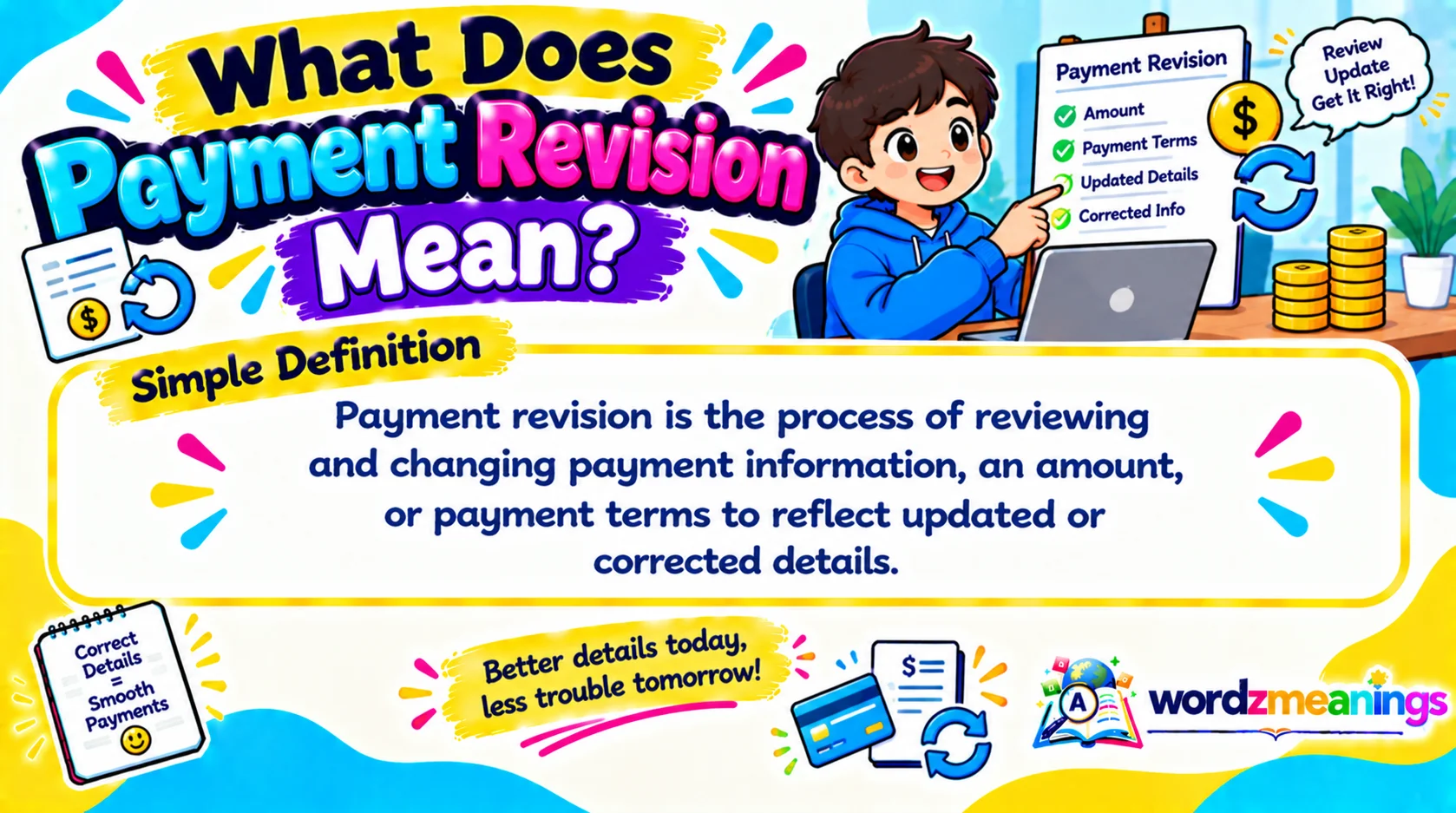
Payment revision is the process of reviewing and changing payment information, an amount, or payment terms to reflect updated or corrected details.
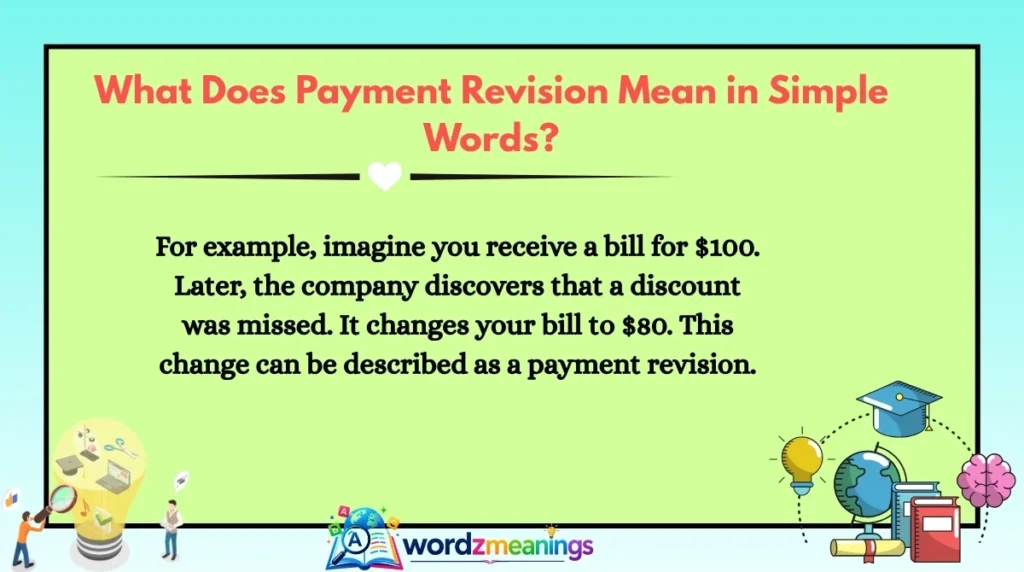
For example, imagine you receive a bill for $100. Later, the company discovers that a discount was missed. It changes your bill to $80. This change can be described as a payment revision.
The phrase doesn’t automatically mean that you owe more money. A revision may increase, decrease, or leave the payment amount unchanged while correcting other details.
Payment Revision Meaning in One Sentence
Payment revision means an existing payment has been updated, corrected, or adjusted because of new information, a mistake, or a change in the payment arrangement.
What Is the Main Idea Behind Payment Revision?
The main idea is that payment information is not staying exactly the same.
A company, employer, government agency, school, service provider, or payment system may review an earlier payment and decide that something needs to be changed.
What Does Payment Revision Mean
- Payment amount
- Payment due date
- Refund amount
- Billing details
- Payment schedule
- Discounts or adjustments
- Payment eligibility
- Account information
The specific change depends on the organization and the situation.
Quick Answer
| Detail | Explanation |
|---|---|
| Meaning | A change, correction, or update to payment details |
| Full Form | Payment Revision is not an abbreviation |
| Pronunciation | PAY-mənt ri-VIZH-ən |
| Category | Financial and administrative term |
| Tone | Neutral and professional |
| Used On | Bills, invoices, payroll, accounts, notices, and payment systems |
| Difficulty Level | Easy to understand |
| One-Line Definition | A review or adjustment that changes or updates existing payment information |
Is Payment Revision an Abbreviation?
What Does Payment Revision Mean
The word payment refers to money given or received. The word revision refers to reviewing and changing something.
Together, the phrase describes an update or adjustment related to a payment.
What Does Revision Mean in Payment?
To understand payment revision clearly, it’s helpful to understand the word revision on its own.
Meaning of Revision
Revision means looking at something again and making changes when needed.
People revise documents, plans, schedules, prices, and financial records. A revision may fix an error, add new information, or change an earlier decision.
When revision is connected to a payment, the review focuses on money or payment-related details.
Meaning of Payment
Payment is money given to someone in exchange for goods, services, work, or an obligation.
Examples include:
- Paying a phone bill
- Receiving a salary
- Paying school fees
- Paying a loan installment
- What Does Payment Revision Mean
- Paying for an online order
When the details of one of these transactions change, the organization may describe the update as a payment revision.
How the Two Words Work Together
The two words have different roles:
- Payment: The money or financial transaction.
- What Does Payment Revision Mean
Therefore, payment revision refers to a change involving a financial transaction or payment arrangement.
Why Does Payment Revision Happen?
Payment revisions happen for different reasons. Sometimes the original payment information was incorrect. In other cases, a new situation requires an update.
1. A Mistake in the Original Payment
A payment may need revision because someone entered the wrong amount or information.
For example, an employee’s salary statement may show an incorrect allowance. After the payroll department checks the records, it updates the amount.
Example:
Your payment has been revised because an earlier calculation contained an error.
What Does Payment Revision Mean
2. A Change in Price
A company may revise a payment when the price of a product or service changes.
For example, a subscription initially costs $20. The company applies a valid price adjustment, and the next payment becomes $25.
The revised amount should be explained in the payment details or applicable agreement.
3. A Discount or Credit Was Added
A payment may be revised after a discount, credit, or adjustment is applied.
For example:
- Original bill: $150
- Approved discount: $30
- Revised bill: $120
What Does Payment Revision Mean
4. A Refund or Return Was Processed
A payment record may change after an order is returned or a refund is approved.
For example, a customer originally paid $75. After returning part of the order, the company revises the transaction to reflect the refund.
The phrase payment revision alone does not confirm whether a refund has already been completed. You should check the payment status and transaction details.
5. A Change in Payment Schedule
Some payment revisions involve timing rather than the total amount.
For example, a loan provider may approve a change in installment dates. The payment schedule is then updated.
A schedule revision might affect:
- What Does Payment Revision Mean
- Number of installments
- Payment frequency
- Amount of each installment
The actual effect depends on the agreement and the reason for the change.
6. New Information Was Received
A payment may be revised when an organization receives updated information.
For example, a benefits office may review a payment after receiving new eligibility or income details. The resulting amount or payment arrangement may change.
A revision notice does not, by itself, explain whether the change is favorable or unfavorable. Read the specific notice to understand the outcome.
What Does Payment Revision Mean on a Bill?
When you see payment revision on a bill, it usually means that billing or payment information has been updated.
Payment Revision on an Electricity Bill
What Does Payment Revision Mean
- A corrected meter reading
- A billing calculation issue
- An approved adjustment
- A change in account details
For example, your first bill shows $90. After the provider corrects a meter reading, the revised bill shows $70.
The revised bill should show the updated amount and, where applicable, an explanation of the change.
Payment Revision on a Phone Bill
A phone company might revise a bill after changing a service charge, applying a credit, or correcting a billing error.
Example:
Your payment revision has been applied to your latest phone bill.
What Does Payment Revision Mean
Payment Revision on a Credit Card Bill
A credit card statement may be adjusted because of a transaction correction, fee reversal, refund, or other account update.
The phrase can refer to an adjustment in the statement, but its exact meaning depends on the issuer’s terminology.
What Should You Check on a Revised Bill?
When you see a payment revision notice, check:
- The original amount.
- The revised amount.
- The reason for the change.
- The due date.
- Any added or removed fees.
- Whether you need to take action.
If the bill doesn’t explain the revision, contact the billing provider through an official channel.
What Does Payment Revision Mean on an Invoice?
An invoice is a document that shows how much a customer or business is expected to pay.
A payment revision on an invoice means that some part of the invoice or payment information has been changed.
Why Is an Invoice Revised?
An invoice may be revised because:
- What Does Payment Revision Mean
- A service charge was missing.
- A tax amount needs correction.
- A discount was added.
- The billing address changed.
- An invoice was issued with incorrect details.
Example of a Revised Invoice
A business sends an invoice for three services at $50 each.
| Item | Original |
|---|---|
| Service quantity | 3 |
| Price per service | $50 |
| Total | $150 |
What Does Payment Revision Mean
| Item | Revised |
|---|---|
| Service quantity | 2 |
| Price per service | $50 |
| Revised total | $100 |
The invoice has been revised to reflect the updated service quantity.
Does a Revised Invoice Mean You Must Pay Again?
What Does Payment Revision Mean
A revised invoice may replace an earlier invoice, correct information, or adjust an outstanding amount. Whether you need to make another payment depends on the payment history and the instructions provided.
Don’t assume that every revised invoice requires a second payment. Check whether the earlier payment was already received and how the revision affects your account.
What Does Payment Revision Mean in Salary or Payroll?
In payroll, payment revision generally refers to a change or correction to an employee’s pay or payment details.
The change may affect gross pay, deductions, allowances, bonuses, or the payment schedule.
Common Reasons for Payroll Payment Revision
What Does Payment Revision Mean
- Incorrect working hours
- Overtime adjustments
- A salary change
- A bonus correction
- Tax or deduction updates
- An error in employee records
- A correction to a previous paycheck
Example of Payment Revision in Salary
Imagine an employee receives a salary statement showing $2,000. The payroll team later discovers that $100 in approved overtime was missing.
What Does Payment Revision Mean
| Description | Amount |
|---|---|
| Original salary | $2,000 |
| Overtime adjustment | $100 |
| Revised gross amount | $2,100 |
What Does Payment Revision Mean
The employee’s final take-home pay may differ because taxes, deductions, or other adjustments can affect the net amount.
Does Payment Revision Mean Your Salary Has Increased?
No. A payment revision does not always mean an increase.
It may result in:
- An increase
- A decrease
- No change in the total amount
- A correction to payment details
What Does Payment Revision Mean
What Does Payment Revision Mean in Banking?
In banking, payment revision may refer to an update or correction to payment-related records or arrangements.
However, banks and financial institutions can use different terminology. The phrase alone does not identify a specific banking action.
Examples of Banking Payment Revisions
Possible situations include:
- Correcting transaction information
- Updating a scheduled payment
- Adjusting a fee or charge
- Revising a payment amount
- Updating an account-related instruction
What Does Payment Revision Mean
Does Payment Revision Mean the Payment Failed?
No. Payment revision and payment failure are not the same thing.
A failed payment means a transaction was not completed successfully. A revision means payment-related information was reviewed or changed.
A payment may be revised before processing, after processing, or during an account correction. You need the payment status to determine whether the transaction succeeded.
What Should You Do When a Bank Shows Payment Revision?
Review the transaction details using your bank’s official app, website, or customer support channel.
Check:
- Transaction amount
- Transaction status
- Date and time
- Reference number
- Any explanation provided
What Does Payment Revision Mean
What Does Payment Revision Mean in Online Shopping?
Online shopping platforms may update payment information when an order changes or a payment issue is reviewed.
Common Online Shopping Situations
What Does Payment Revision Mean
- An item is removed from an order.
- A product price changes before shipment.
- Shipping charges are adjusted.
- A discount is applied.
- A refund is processed.
- What Does Payment Revision Mean
Example of Payment Revision in an Online Order
You order two products for $60. One product becomes unavailable, so the order total is adjusted to $35.
The platform may revise the payment details to reflect the changed order.
The exact process differs between shopping websites. Look for the updated order total and payment status.
Does Payment Revision Mean My Order Is Canceled?
Not automatically.
A payment revision may relate to an order adjustment without canceling the order. To determine whether an order is canceled, check the order status separately.
What Does Payment Revision Mean in Government Payments or Benefits?
Government agencies and benefit programs may review payments based on eligibility, records, income, or other rules.
In this context, payment revision may refer to a change in the amount or details of an approved or scheduled payment.
Why Government Payments May Be Revised
What Does Payment Revision Mean
- Updated eligibility information
- Corrected records
- Changes in approved benefits
- Payment calculation adjustments
- Changes in reporting information
The rules and terminology differ by program and location.
Example of a Benefit Payment Revision
A person receives a notice that their benefit payment has been revised after the agency reviews updated information.
What Does Payment Revision Mean
Important: Don’t assume that a revision means benefits have been canceled or reduced. Read the official notice to understand the actual decision.
What Does Payment Revision Mean on a Payment App?
Payment apps may show different messages when a transaction is updated, reviewed, or adjusted.
The phrase payment revision is not a universal status label used in exactly the same way by every payment application.
Possible Reasons for Seeing the Phrase
You might see a payment-related revision message when:
- A transaction amount changes.
- A payment request is updated.
- A refund affects the transaction.
- Account information is corrected.
- What Does Payment Revision Mean
The precise meaning depends on the app, transaction, and surrounding message.
How to Understand the Message
Read the full notification rather than focusing only on the words payment revision.
Look for details such as:
- Revised amount
- Transaction status
- Merchant name
- Payment date
- Reason for the update
- What Does Payment Revision Mean
If the notification asks for sensitive information or directs you to an unfamiliar website, verify it through the official app or website before taking action.
Payment Revision vs Payment Adjustment
Payment revision and payment adjustment are closely related, but they aren’t always identical in every system.
What Is Payment Adjustment?
A payment adjustment usually refers to a change made to a payment amount or account balance.
What Does Payment Revision Mean
What Is Payment Revision?
Payment revision is a broader phrase that can describe reviewing and changing payment information, amounts, or terms.
Comparison Table
| Feature | Payment Revision | Payment Adjustment |
|---|---|---|
| Main idea | Review or change of payment details | Change to an amount, balance, or related record |
| Possible purpose | Correction, update, or modification | Credit, charge correction, or financial change |
| Amount affected? | Sometimes | Often |
| Meaning in every system | Not fixed | Not fixed |
| Exact interpretation | Depends on context | Depends on context |
What Does Payment Revision Mean
Payment Revision vs Payment Reversal
These phrases can look similar, but they describe different ideas.
What Is Payment Reversal?
A payment reversal generally means a transaction is undone or returned through a payment system.
For example, a transaction may be reversed because it was canceled, duplicated, or could not be completed as intended.
Difference Between Revision and Reversal
| Payment Revision | Payment Reversal |
|---|---|
| Payment information is reviewed or changed | A transaction is undone or returned |
| May change an amount or detail | Often affects the transaction’s completed or pending state |
| Doesn’t automatically mean money is returned | May involve returning or restoring funds |
| Meaning depends on the system | Exact process depends on the payment provider |
What Does Payment Revision Mean
Payment Revision vs Payment Correction
A correction is one possible reason for a payment revision.
Payment Correction Meaning
Payment correction means fixing an error in payment information or calculations.
For example, a company accidentally enters $500 instead of $50. It corrects the amount to reflect the intended transaction.
How They Are Related
What Does Payment Revision Mean
Payment correction focuses on fixing an error.
A correction may be a revision, but not every revision is necessarily a correction. Some revisions happen because of a new agreement, updated information, or a change in circumstances.
Does Payment Revision Mean You Owe More Money?
No. Payment revision does not automatically mean you owe more money.
A revised payment can increase, decrease, or leave the total unchanged.
When the Amount May Increase
A payment may increase because of:
- An added service
- An approved fee
- A price change
- What Does Payment Revision Mean
- A change in the payment arrangement
When the Amount May Decrease
A payment may decrease because of:
- A discount
- A refund
- A credit
- A removed service
- What Does Payment Revision Mean
When the Amount May Stay the Same
A revision may only change:
- Your billing address
- The payment date
- The payment method
- A reference number
- Other administrative details
The revised amount and the reason for the change are more important than the phrase alone.
Does Payment Revision Mean I Need to Pay Again?
Not necessarily.
Whether you need to pay again depends on the payment history and the instructions from the organization.
Situations Where Another Payment May Be Needed
You may need to make an additional payment if:
- The original payment was incomplete.
- The revised amount is higher and the difference is due.
- A previous payment was canceled or returned.
- The organization specifically requests an additional amount.
Situations Where You May Not Need to Pay Again
You may not need to make another payment if:
- The revision only corrects administrative details.
- Your original payment was already received.
- The revision replaces an earlier invoice.
- The amount was adjusted through an approved credit.
Always verify the balance and payment status before paying a second time.
How to Read a Payment Revision Notice
A payment revision notice should be understood by looking at the details around the phrase.
Step 1: Identify the Organization
Find out who issued the notice.
It could be:
- A bank
- An employer
- A school
- A service provider
- A government agency
- An online shopping platform
The organization helps you understand which payment rules may apply.
Step 2: Check the Original Amount
Find the amount listed before the revision, if available.
This helps you compare the earlier payment with the updated information.
Step 3: Check the Revised Amount
Look for the new amount, if one is shown.
The revised amount may be higher, lower, or unchanged.
Step 4: Read the Reason
Look for an explanation such as:
- Calculation correction
- Updated information
- Refund adjustment
- Schedule change
- Account update
If no reason is given, ask the organization for clarification.
Step 5: Check the Payment Status
A revision notice and a successful payment confirmation are not necessarily the same thing.
Look for statuses such as:
- Pending
- Completed
- Failed
- Canceled
- Refunded
- Under review
The exact labels differ by platform.
Step 6: Check Whether You Need to Act
Some notices are informational. Others require you to confirm information or make a payment.
Follow only verified instructions from the relevant organization.
Real-Life Examples of Payment Revision
The following examples show how the phrase may be used in different settings.
Example 1: A Revised Utility Bill
Situation: A water company discovers an error in a bill.
Your payment has been revised after the meter reading was corrected.
Explanation: The company reviewed the original billing information and changed the amount based on the corrected reading.
Example 2: A Revised Salary Statement
Situation: An employer adds approved overtime pay.
Your payroll payment has been revised to include overtime hours.
Explanation: The employee’s pay calculation was updated. The final amount depends on any applicable deductions.
Example 3: A Revised Online Order
Situation: A customer removes an item from an order.
The payment total has been revised after your order was updated.
Explanation: The payment details changed because the order contents changed.
Example 4: A Revised Payment Schedule
Situation: A lender approves a change to the installment dates.
Your payment schedule has been revised.
Explanation: The schedule has been updated. The notice should be checked for the new dates and any changes to the amount.
Example 5: A Revised Invoice
Situation: A business finds an incorrect charge.
We have issued a revised invoice to correct the billing error.
Explanation: The invoice was updated to reflect the corrected charge.
Example 6: A Revised Refund
Situation: A store updates a refund calculation.
Your refund amount has been revised following a review of the returned items.
Explanation: The refund calculation has changed. The customer should check the revised amount and refund status.
Conversation Examples Using Payment Revision
The phrase is more common in formal or administrative communication than in casual slang.
Conversation 1: Asking About a Revised Bill
Customer: I received a payment revision notice. What changed?
Billing Agent: We corrected the service charge on your account.
Customer: Do I need to make another payment?
Billing Agent: Please check the updated balance and payment status.
Explanation: The customer is asking about the reason for the revision and whether any additional payment is required.
Conversation 2: Asking an Employer About Payroll
Employee: My salary statement says payment revision. Can you explain it?
Payroll Officer: We updated your overtime calculation.
Employee: Does that change my final salary?
Payroll Officer: The revised statement shows the updated calculation and applicable deductions.
Explanation: The employee wants to know how the payroll change affects their earnings.
Conversation 3: Asking an Online Store
Customer: Why was my payment total revised?
Support Agent: One item was removed from your order, so the total was updated.
Customer: Will I receive a refund for the difference?
Support Agent: Please check the order’s refund details.
Explanation: The customer is checking how a change in the order affects the payment.
Conversation 4: Asking About a Payment Schedule
Customer: I received a revised payment schedule. What should I check?
Support Agent: Review the new dates, installment amounts, and any instructions.
Customer: Should I follow the old schedule?
Support Agent: Use the applicable confirmed schedule and contact the provider if anything is unclear.
Explanation: The conversation focuses on understanding a revised schedule before making a payment.
Is Payment Revision a Formal or Casual Phrase?
Payment revision is generally a formal or administrative phrase.
You are more likely to see it in financial records, workplace communication, billing notices, or account systems than in casual conversations.
Where Is Payment Revision Commonly Used?
It may appear in:
- Emails from billing departments
- Payroll messages
- Invoice documents
- Financial statements
- Payment portals
- Customer support conversations
- Administrative notices
The phrase is understandable in professional communication, but some organizations may use more specific terms such as payment adjustment, revised invoice, or corrected payment details.
Is Payment Revision Slang?
No. Payment revision is not common internet slang or a social media abbreviation.
It is a standard phrase made from two ordinary English words.
Is Payment Revision Rude?
No. The phrase itself is neutral.
Its tone depends on the surrounding message. A notice about an increased bill may feel concerning, but the words payment revision are not insulting or disrespectful.
Is Payment Revision Flirty?
No. Payment revision has no standard romantic or flirty meaning.
If someone uses the phrase in a personal message, the meaning will usually depend on the actual context rather than any recognized slang definition.
Does Payment Revision Have Different Meanings?
Yes. The phrase can refer to different types of payment-related changes.
Revision of a Payment Amount
This means the amount is changed.
Example: A bill changes from $100 to $85 after a credit is applied.
Revision of Payment Details
This means information about the payment is updated.
Example: A payment record is corrected to show the right account number or transaction reference.
Revision of Payment Terms
This means the conditions of a payment arrangement are changed.
Example: An approved payment plan has a new installment date.
Revision of Payment Records
This means an existing record is updated to reflect accurate information.
Example: A financial department corrects a previous entry in its payment system.
These meanings are related, but the exact interpretation depends on the source of the notice.
Common Mistakes People Make About Payment Revision
Payment revision is easy to misunderstand when a notice doesn’t explain the full situation.
Mistake 1: Assuming the Payment Always Increased
A revision may increase or decrease the amount. It may also leave the amount unchanged.
Better approach: Compare the original and revised amounts.
Mistake 2: Assuming the Payment Failed
A revised payment is not automatically a failed payment.
Better approach: Check the actual transaction status.
Mistake 3: Assuming You Must Pay Again
A revision doesn’t always create a new amount due.
Better approach: Check the balance and payment history before sending money.
Mistake 4: Assuming the Revision Is a Refund
A revision may involve a refund, but the phrase alone does not confirm that money will be returned.
Better approach: Look for specific refund information.
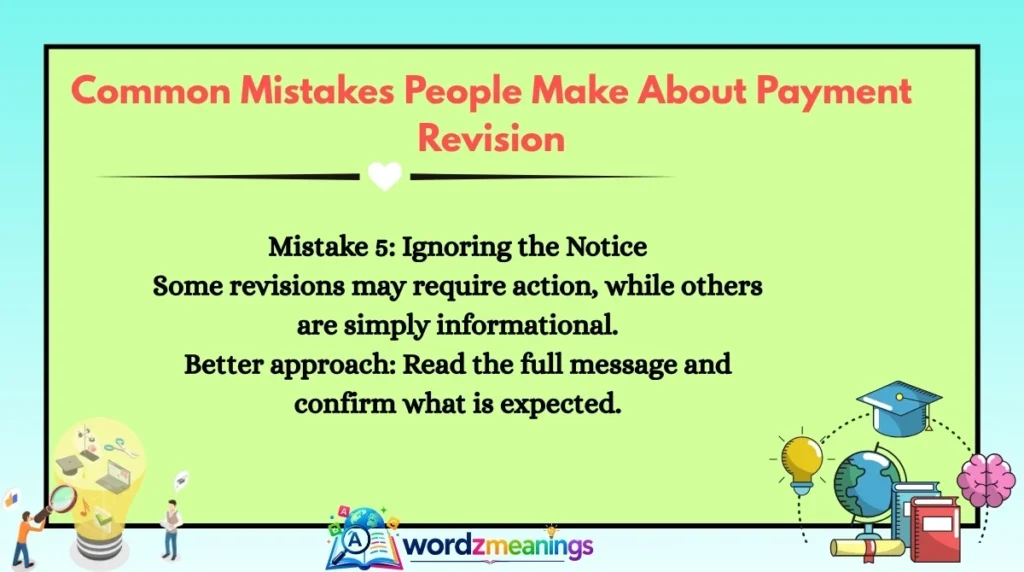
Mistake 5: Ignoring the Notice
Some revisions may require action, while others are simply informational.
Better approach: Read the full message and confirm what is expected.
Mistake 6: Treating Every Company’s Wording as Identical
Different organizations use payment terms in different ways.
Better approach: Use the notice’s context and the organization’s explanation to understand the meaning.
How to Reply to a Payment Revision Notice
Your reply should depend on what you want to know.
If You Want to Ask for the Reason
You can say:
Could you please explain why my payment was revised?
This is polite and direct.
If You Want to Ask About the New Amount
Could you confirm the original and revised payment amounts?
This helps you understand the difference.
If You Want to Know Whether You Must Pay Again
Does this revision require any additional payment from me?
This question is useful when the notice doesn’t clearly explain what you need to do.
If You Want to Ask About a Revised Invoice
Could you please confirm whether the revised invoice replaces the previous one?
This helps prevent confusion about duplicate payments.
If You Want to Ask About a Payroll Revision
Could you explain how this payment revision affects my final pay?
This is appropriate when you need clarification from a payroll department.
What Should You Do If a Payment Revision Seems Wrong?
If the revised amount or information looks incorrect, don’t ignore it.
Review the Original Payment
Compare the earlier record with the revised notice.
Check whether the original amount, date, and payment details match your records.
Contact the Correct Organization
Use the official customer support channel, payroll department, bank, or billing office.
Explain what appears incorrect and ask for a clear breakdown.
Keep Relevant Records
Save:
- Original invoice
- Revised invoice
- Payment confirmation
- Emails or notices
- Relevant transaction details
These records can help you explain the issue.
Avoid Sending a Duplicate Payment
If you’re unsure whether the first payment was completed, verify its status before paying again.
This is especially important when a notice is unclear or an amount appears unexpectedly different.
Payment Revision in Different Countries and Systems
The general meaning of payment revision is similar across many settings, but the exact usage can vary.
Why Terminology May Differ
Different organizations and countries have different:
- Billing systems
- Financial regulations
- Payroll processes
- Payment terminology
- Administrative procedures
A term used by one company may not be an official status label at another company.
Example of Different Wording
One organization might say:
Your payment has been revised.
Another might say:
Your billing amount has been adjusted.
A third might say:
Your payment record has been corrected.
These messages may describe related actions, but they are not guaranteed to mean exactly the same thing.
Best Way to Understand the Local Context
Focus on the complete notice, the payment amount, and the organization’s explanation.
If the message involves legal obligations, benefits, taxes, or a financial contract, check the applicable official information rather than relying only on the general meaning of the phrase.
Frequently Asked Questions
What does payment revision mean?
Payment revision means an existing payment or payment-related information has been reviewed and changed. The change may involve an amount, date, record, or payment terms.
Does payment revision mean I have to pay more?
No. A payment revision can increase, decrease, or leave the payment amount unchanged. Check the revised amount and the reason for the change.
Is payment revision the same as payment adjustment?
Not always. The phrases are related, but payment adjustment often focuses on a change to an amount or balance, while payment revision can describe a broader review or update.
Does payment revision mean the payment was successful?
No. A revision notice does not automatically confirm that a payment was completed. Check the transaction status.
Does payment revision mean my payment was canceled?
No. Cancellation is a separate action. Read the payment status and the explanation in the notice.
Can payment revision mean a refund?
It can be related to a refund or refund adjustment, but the phrase alone does not confirm that a refund has been issued.
Is payment revision a banking term?
It can be used in banking or payment-related communication, but its exact meaning depends on the institution and its internal terminology.
Is payment revision used in salary payments?
Yes. It may describe a correction or update to payroll amounts, deductions, overtime, or payment records.
Is payment revision an official status?
It may be an official label in a particular system, but it is not a universal payment status with one fixed definition.
What should I do after receiving a payment revision notice?
Read the notice carefully, compare the original and revised details, check the payment status, and contact the relevant organization if anything is unclear.
Can a payment revision change the due date?
Yes, it may affect a due date if the revision involves payment scheduling. Check the updated notice for the applicable date.
What is the difference between a payment revision and a revised invoice?
A payment revision is a broader payment-related update. A revised invoice is a billing document that has been changed or reissued. The exact relationship depends on the billing process.
Does payment revision mean a mistake was made?
Sometimes. A revision may correct an error, but it can also result from a new price, an approved change, or updated information.
Is payment revision a negative term?
No. It is neutral. The effect of a revision depends on what was changed and why.
Can payment revision affect my account balance?
Yes. If the revision changes a payment amount, charge, refund, or credit, it may affect the account balance. Review the updated account information.
Should I contact customer support about a payment revision?
Contact customer support if the notice is unclear, the amount looks incorrect, or you don’t know whether action is required.
Key Differences Between Related Payment Terms
| Term | Simple Meaning |
|---|---|
| Payment revision | A review or update of payment information or arrangements |
| Payment adjustment | A change to a payment amount, balance, or related record |
| Payment correction | Fixing an error in payment details |
| Payment reversal | Undoing or returning a transaction through a payment system |
| Payment refund | Money returned to the customer or payer |
| Payment failure | A payment that was not completed successfully |
| Payment confirmation | A message or record confirming a payment event |
These are general explanations. A particular bank, company, or platform may define or display them differently.
Conclusion
Payment revision means a payment or payment-related information has been reviewed and changed. It may involve an updated amount, corrected record, revised payment schedule, or another financial detail.
The phrase doesn’t automatically mean that you owe more money, that your payment failed, or that you must pay again. The real meaning depends on the notice, the organization, and the changes made.
When you see a payment revision message, compare the original and revised details, check the payment status, and ask the relevant organization for clarification if necessary.
Understanding the full context helps you avoid confusion and make the right decision about your payment.

I am Brandon Ellis, a language enthusiast and content writer at WordzMeanings. I create clear, accurate, and easy-to-understand explanations of words, phrases, and expressions to help readers improve their English every day.



