
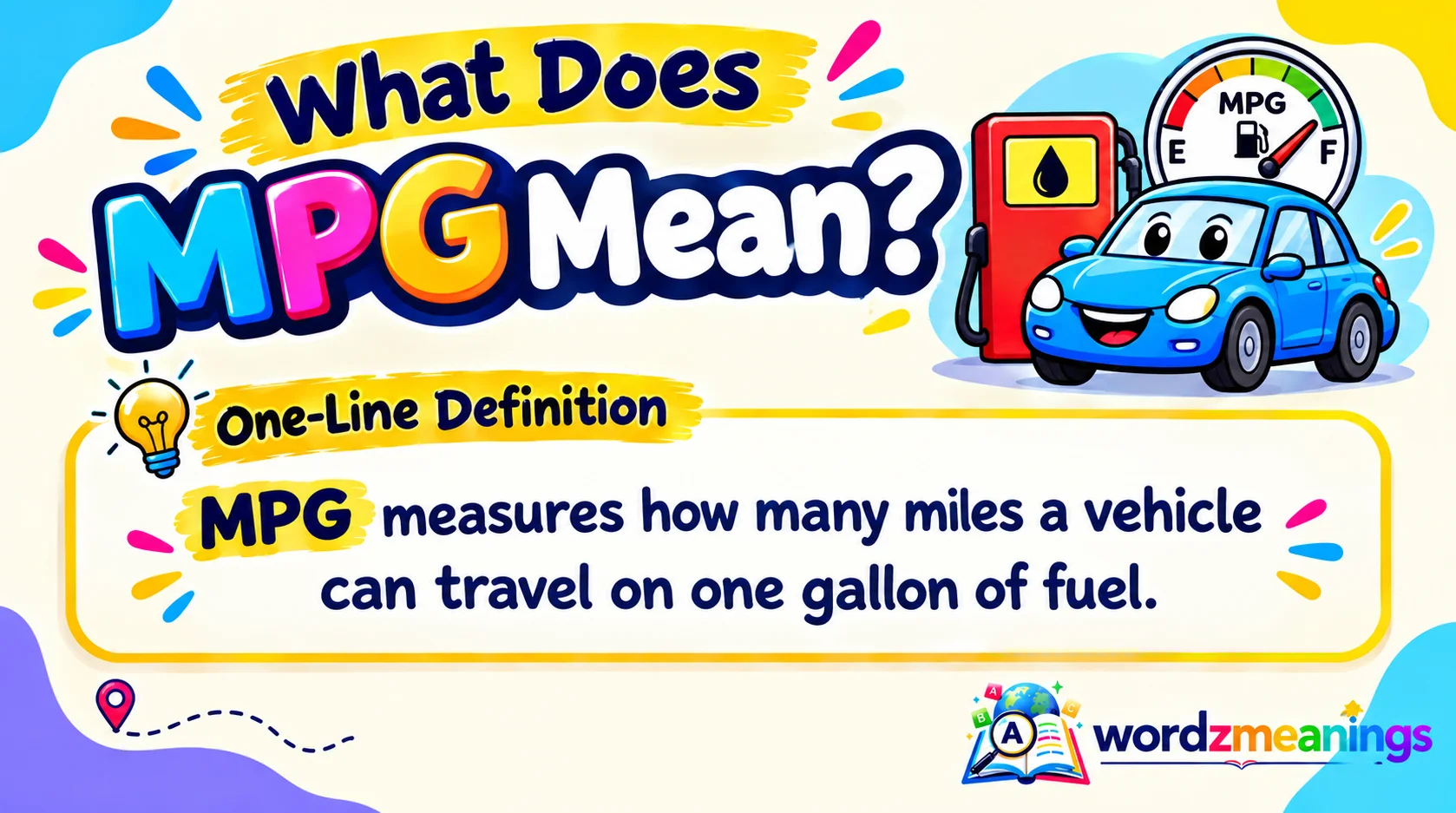
If you’ve ever looked at a car’s dashboard, window sticker, or vehicle review and wondered what does mpg mean, it means miles per gallon.
MPG tells you how many miles a vehicle can travel using one gallon of fuel.
A higher MPG usually means better fuel economy and fewer trips to the gas station.
Quick Answer
Meaning
MPG means miles per gallon.
Full Form
MPG = Miles Per Gallon
Pronunciation
MPG is usually said as “M-P-G”, letter by letter.
Category
Automotive and fuel-economy abbreviation.
Tone
Neutral and practical.
Used On
Cars, trucks, SUVs, motorcycles, vehicle advertisements, fuel-economy labels, dashboards, and car reviews.
Difficulty Level
Easy.
One-Line Definition
MPG measures how many miles a vehicle can travel on one gallon of fuel.
MPG Means Miles Per Gallon
The abbreviation MPG describes a vehicle’s fuel efficiency. The first part, miles, tells you the distance. The last part, gallon, tells you the amount of fuel used.
For example, if a car gets 30 MPG, it can travel about 30 miles on one gallon of fuel under the conditions used for that MPG rating.
In simple terms:
Higher MPG = more miles from the same amount of fuel.
Lower MPG = fewer miles from the same amount of fuel.
What Does MPG Mean
A Simple MPG Example
Imagine two cars:
- Car A gets 20 MPG.
- Car B gets 40 MPG.
If both cars have one gallon of fuel available, Car A can travel about 20 miles, while Car B can travel about 40 miles.
So, Car B has better fuel economy.
However, real-world fuel use can be different from the advertised MPG because driving conditions, speed, traffic, weather, vehicle load, tire pressure, and driving habits can all affect fuel consumption.
Why Do People Use MPG?
MPG Helps Compare Vehicles
What Does MPG Mean
A large SUV may have a lower MPG than a small compact car. A hybrid may achieve much higher MPG than a traditional gasoline-powered vehicle.
When shopping for a vehicle, MPG can help you understand how much fuel the vehicle may need during normal driving.
MPG Helps Estimate Fuel Costs
MPG can also help you estimate how much you may spend on fuel.
Suppose you drive 1,000 miles and your car gets 25 MPG.
You can estimate the fuel required like this:
1,000 ÷ 25 = 40 gallons
So, you would need about 40 gallons of fuel to travel 1,000 miles under those conditions.
If fuel costs $3 per gallon, the estimated fuel cost would be:
40 × $3 = $120
What Does MPG Mean
MPG Helps Explain Fuel Economy
People often use MPG and fuel economy together.
For example, someone might say:
“This car has good MPG.”
They usually mean the vehicle can travel a relatively long distance without using a large amount of fuel.
What Does MPG Stand For?
MPG Full Form
What Does MPG Mean
Miles Per Gallon
Each part has a simple meaning:
| Part | Meaning |
|---|---|
| Miles | Distance traveled |
| Per | For each |
| Gallon | Amount of fuel |
What Does MPG Mean
Is MPG Only Used for Cars?
No. MPG is most commonly associated with cars and other road vehicles, but it can also be used when discussing other fuel-powered vehicles.
You may see MPG mentioned for:
- Cars
- SUVs
- Pickup trucks
- Vans
- Motorcycles
- Some recreational vehicles
- What Does MPG Mean
The exact way fuel economy is measured can vary by vehicle type and testing system.
How Is MPG Calculated?
The Basic MPG Formula
The basic formula is:
MPG = Miles Driven ÷ Gallons of Fuel Used
For example, suppose you drive 300 miles and use 10 gallons of fuel.
300 ÷ 10 = 30 MPG
Your vehicle’s fuel economy for that trip would be 30 MPG.
Another Easy Example
What Does MPG Mean
450 ÷ 15 = 30 MPG
That means your vehicle averaged 30 miles per gallon during that trip.
The calculation is simple, but the result can change from one trip to another.
Why Your Actual MPG May Change
Your vehicle may be advertised as getting 30 MPG, but you might sometimes get 27 MPG or 33 MPG.
That’s normal.
Your actual fuel economy can be affected by:
- Driving speed
- Traffic
- Frequent braking
- Fast acceleration
- Highway What Does MPG Mean
- City driving
- Cold weather
- Air conditioning
- Tire pressure
- Vehicle weight
- Road conditions
- Engine condition
- Driving style
So, an MPG number should generally be viewed as a useful measurement rather than a guarantee.
What Is Good MPG?
There Is No Single “Good MPG” Number
A good MPG depends on the type of vehicle.
For example, what is considered good for a large pickup truck may not be considered good for a small economy car.
A vehicle with 25 MPG might be reasonable for one category but poor for another.
This is why it’s better to compare vehicles that are similar in size and purpose.
Higher MPG Usually Means Better Fuel Economy
In general, a higher MPG number means the vehicle uses less fuel to travel the same distance.
What Does MPG Mean
| Vehicle | MPG | General Fuel Efficiency |
|---|---|---|
| Vehicle A | 15 MPG | Lower |
| Vehicle B | 25 MPG | Better |
| Vehicle C | 35 MPG | Better |
| Vehicle D | 50 MPG | Very high |
This doesn’t mean MPG is the only thing you should consider when choosing a vehicle. Purchase price, maintenance, insurance, performance, reliability, cargo space, and driving needs can also matter.
What Does MPG Mean on a Car?
MPG on a Dashboard
If you see MPG on your vehicle’s dashboard, it may show your current or average fuel economy.
For example, your display might show:
28 MPG
This means the vehicle is averaging about 28 miles for each gallon of fuel based on the measurement being displayed.
Some vehicles show instant MPG, while others show average MPG.
Instant MPG vs Average MPG
These numbers are not necessarily the same.
Instant MPG reflects fuel efficiency at a particular moment.
Average MPG represents fuel efficiency over a longer period or distance.
For example, you might get high MPG while cruising steadily on a highway but much lower MPG during stop-and-go traffic.
What Does NFS Mean Slang
Why Dashboard MPG Can Change
It is normal for the MPG number on a dashboard to move up and down.
For example:
You might see:
22 MPG → 25 MPG → 29 MPG → 24 MPG
That doesn’t necessarily mean something is wrong with the vehicle.
Changes in speed, acceleration, traffic, hills, and other driving conditions can quickly affect fuel economy.
What Does MPG Mean in a Car Advertisement?
MPG Ratings on Vehicle Listings
When you’re looking at a car advertisement, you may see numbers such as:
25 city / 32 highway MPG
These numbers describe expected fuel economy under standardized testing conditions.
The city number represents driving conditions designed to resemble urban driving.
The highway number represents conditions designed to resemble highway driving.
City MPG
City MPG refers to fuel economy under city-style driving conditions.
City driving often includes:
- Frequent stops
- Traffic lights
- Starting and stopping
- Lower average speeds
- More acceleration and braking
Because of this, city MPG is often lower than highway MPG.
Highway MPG
Highway MPG refers to fuel economy under highway-style driving conditions.
Steady driving at moderate speeds can allow a vehicle to use fuel more efficiently than repeated stopping and starting.
However, extremely high speeds can also reduce fuel economy.
Combined MPG
You may also see combined MPG.
This is intended to provide a single fuel-economy figure that combines city and highway driving.
It can be useful when you want one number for a quick comparison.
MPG vs Gas Mileage: Are They the Same?
MPG and Gas Mileage
In everyday conversation, MPG and gas mileage are often used to describe the same basic idea.
For example:
“What kind of gas mileage does your car get?”
A person might answer:
“About 30 MPG.”
In this context, gas mileage means the vehicle’s fuel economy, expressed in miles per gallon.
Fuel Economy vs MPG
There is a small difference in wording.
Fuel economy is the broader concept of how efficiently a vehicle uses fuel.
MPG is one way of expressing that efficiency.
So you can think of it like this:
Fuel economy = the concept
MPG = a measurement used to describe it
MPG vs MPGe
What Does MPGe Mean?
You may also come across MPGe, especially when reading about electric vehicles and plug-in hybrids.
MPGe means:
Miles Per Gallon Equivalent
It is designed to compare the energy consumption of vehicles that don’t use gasoline in the same way as conventional gasoline vehicles.
Regular MPG measures miles traveled per gallon of gasoline.
MPGe uses an energy-equivalent measurement so different types of vehicles can be compared using a familiar miles-per-gallon-style number.
MPG and MPGe Comparison
| Term | Full Form | Common Use |
|---|---|---|
| MPG | Miles Per Gallon | Gasoline or fuel-powered vehicles |
| MPGe | Miles Per Gallon Equivalent | Electric and alternative-fuel vehicle energy comparison |
MPGe should not be treated as exactly the same thing as regular MPG.
MPG vs L/100 km
MPG Is Not Used Everywhere
MPG is especially common in the United States and some other places.
Other countries commonly use liters per 100 kilometers, written as L/100 km.
These measurements work differently.
With MPG:
Higher number = better fuel economy
With L/100 km:
Lower number = better fuel economy
For example, a vehicle using 6 L/100 km is generally more efficient than one using 10 L/100 km.
Why the Two Measurements Can Be Confusing
Someone familiar with MPG may initially find L/100 km confusing because the direction is reversed.
With MPG, you’re asking:
How many miles can I travel using one gallon?
With L/100 km, you’re asking:
How many liters of fuel are needed to travel 100 kilometers?
That difference is important when comparing international vehicle specifications.
What Does MPG Mean for Fuel Costs?
MPG Can Help Estimate Your Spending
MPG can give you a useful way to estimate fuel costs.
Suppose:
- You drive 1,200 miles.
- Your car gets 30 MPG.
- Fuel costs $3.50 per gallon.
First, calculate gallons used:
1,200 ÷ 30 = 40 gallons
Then calculate the cost:
40 × $3.50 = $140
So your estimated fuel cost is $140.
Your real cost could be different if your actual MPG changes.
Why a Small MPG Difference Can Matter
A difference in MPG may seem small, but it can become meaningful when you drive many miles.
For example, consider two vehicles:
- Vehicle A: 20 MPG
- Vehicle B: 30 MPG
For 600 miles:
600 ÷ 20 = 30 gallons
600 ÷ 30 = 20 gallons
Vehicle B would use about 10 fewer gallons for those 600 miles.
Over thousands of miles, differences in fuel economy can add up.
What Does MPG Mean for Long Trips?
MPG Helps With Road Trip Planning
If you’re planning a long road trip, MPG can help you estimate how much fuel you’ll need.
For example, imagine a 900-mile trip in a car that averages 30 MPG.
900 ÷ 30 = 30 gallons
You’d estimate roughly 30 gallons of fuel for the trip.
This can help you plan your fuel budget and understand how often you may need to stop.
Don’t Treat the Estimate as Exact
A road-trip MPG estimate is not a promise.
Mountain roads, heavy luggage, strong winds, traffic, high speeds, and weather can all affect fuel consumption.
It’s smart to leave some room in your fuel planning rather than relying on the exact advertised MPG.
Common Questions About MPG
Is Higher MPG Better?
Usually, yes.
A higher MPG generally means a vehicle can travel farther using the same amount of fuel.
However, the best MPG depends on what you need from a vehicle. A large truck may naturally have lower MPG than a small car because it is designed for different jobs.
Does MPG Mean Miles Per Gas?
No.
MPG officially means miles per gallon.
The word gallon refers to a unit of volume used for fuel.
Some people casually explain MPG as miles per gas, but that isn’t the correct full form.
Is 30 MPG Good?
For many gasoline-powered vehicles, 30 MPG can represent fairly efficient fuel use, but whether it is “good” depends on the vehicle type and whether the number refers to city, highway, or combined driving.
A 30 MPG rating should be compared with similar vehicles rather than judged by itself.
Does Higher MPG Save Money?
Generally, yes.
If two vehicles travel the same distance and one uses less fuel, the more fuel-efficient vehicle can cost less to operate when fuel prices and other costs are equal.
Can I Improve My MPG?
You can often improve real-world fuel economy through sensible driving and vehicle care.
Helpful habits include:
- Avoid unnecessary rapid acceleration.
- Keep tires properly inflated.
- Avoid carrying unnecessary weight.
- Reduce excessive idling.
- Drive smoothly.
- Follow the vehicle’s maintenance schedule.
- Avoid unnecessary high speeds.
These habits don’t guarantee a specific MPG increase, but they can help reduce wasted fuel.
Common Misunderstandings About MPG
MPG Is Not a Fixed Speed
MPG does not mean the vehicle must travel at a certain speed.
It is a fuel-efficiency measurement.
A car can achieve different MPG figures at different speeds and under different driving conditions.
The Advertised MPG Isn’t Always Your Real MPG
Official MPG figures are useful for comparing vehicles, but your personal result can differ.
Two people can drive the same car and get different MPG because they may have different routes, speeds, traffic conditions, loads, and driving habits.
A Bigger MPG Number Isn’t Always the Whole Story
MPG is useful, but it isn’t the only factor to consider when evaluating a vehicle.
A vehicle with excellent MPG might have a higher purchase price, different maintenance costs, or less cargo space.
Looking at the complete cost of ownership gives you a better picture.
Common MPG Mistakes
Thinking MPG Is the Same at All Times
It isn’t.
Your MPG can change from one trip to another.
A vehicle might achieve excellent fuel economy on one highway trip and much lower fuel economy during another trip through heavy traffic.
Assuming Advertised MPG Is Guaranteed
Advertised MPG is useful for comparison, but it isn’t a guarantee of what every driver will experience.
Your driving environment can be very different from standardized testing conditions.
Thinking 40 MPG Always Uses Half the Fuel of 20 MPG
This needs careful explanation.
For the same distance, a 40 MPG vehicle does use half as much fuel as a 20 MPG vehicle.
For example, over 400 miles:
20 MPG = 20 gallons
40 MPG = 10 gallons
So the 40 MPG vehicle uses half as much fuel for that distance.
Frequently Asked Questions
What does MPG mean in a car?
MPG means miles per gallon. It measures how many miles a vehicle can travel using one gallon of fuel.
What does 30 MPG mean?
30 MPG means the vehicle can travel about 30 miles using one gallon of fuel under the conditions represented by that measurement.
Is 20 MPG bad?
Not necessarily. Whether 20 MPG is good or poor depends on the vehicle. A large truck and a small compact car should not be judged by the same MPG expectations.
Is 40 MPG good?
40 MPG is generally considered strong fuel economy for many gasoline-powered vehicles, although the meaning depends on the vehicle type and whether the number refers to city, highway, or combined driving.
Why does my MPG keep changing?
Your MPG can change because of speed, traffic, acceleration, braking, weather, road conditions, tire pressure, vehicle load, and other factors.
Does MPG mean fuel efficiency?
Yes. MPG is a common way of expressing a vehicle’s fuel efficiency.
What does MPG stand for?
MPG stands for Miles Per Gallon.
What is the difference between MPG and MPGe?
MPG means miles per gallon, while MPGe means miles per gallon equivalent. MPGe is used to express energy consumption for vehicles such as electric vehicles in a way that allows comparison with traditional fuel economy measurements.
What is better, higher or lower MPG?
For MPG, a higher number is generally better because it means the vehicle can travel more miles using one gallon of fuel.
Does MPG affect how much gas I use?
Yes. A vehicle with lower MPG generally needs more fuel to travel the same distance than a vehicle with higher MPG.
Conclusion
The Simple Meaning of MPG
MPG means miles per gallon.
It’s one of the easiest ways to understand a vehicle’s fuel economy. If a car gets 30 MPG, it can travel about 30 miles on one gallon of fuel under the conditions represented by that rating.
When comparing vehicles, don’t look at MPG alone. Consider how much you drive, where you drive, fuel prices, vehicle size, maintenance costs, and your everyday needs.
The key rule is simple:
Higher MPG generally means better fuel economy and less fuel used for the same distance.

I am Brandon Ellis, a language enthusiast and content writer at WordzMeanings. I create clear, accurate, and easy-to-understand explanations of words, phrases, and expressions to help readers improve their English every day.



