
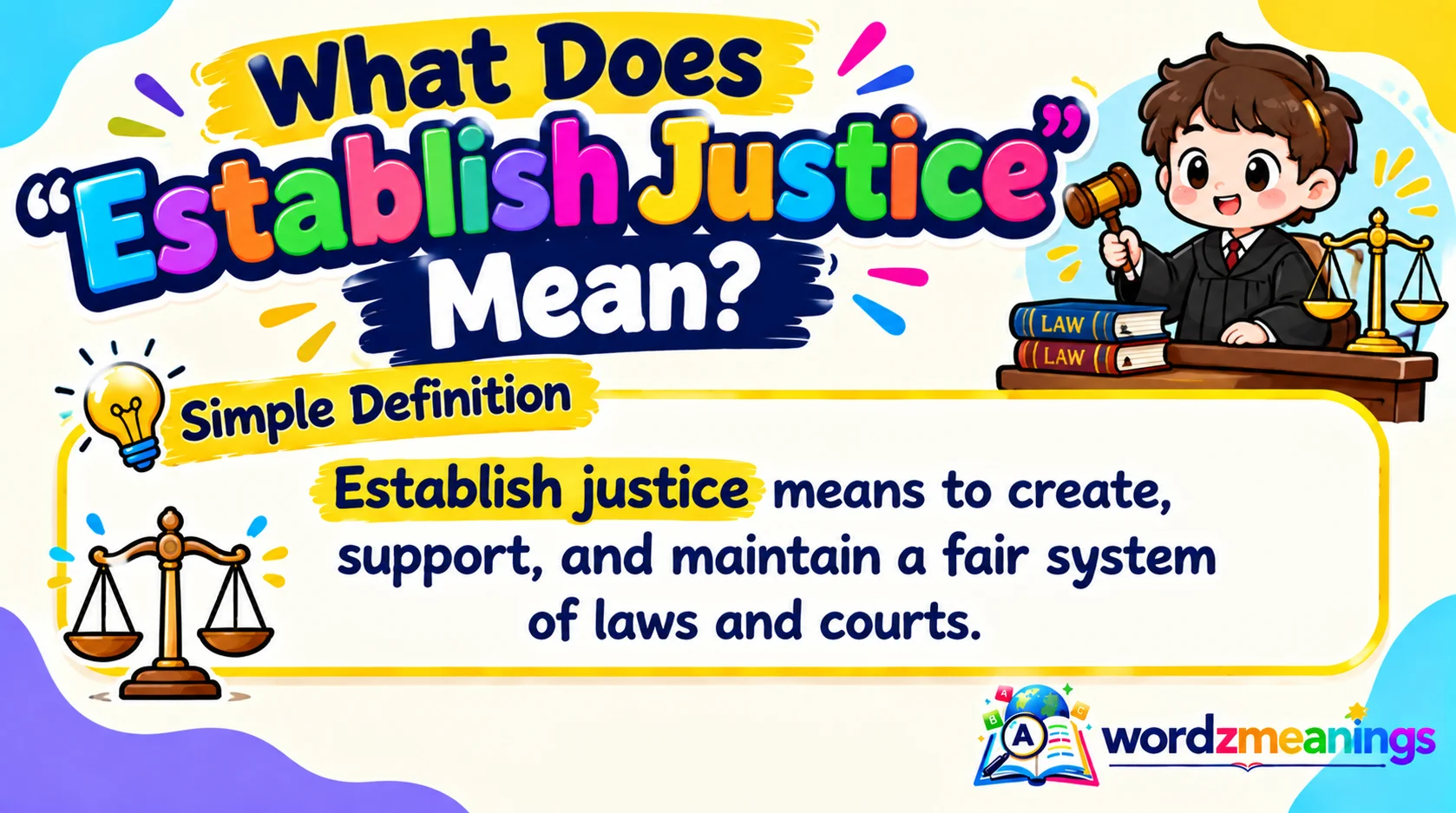
The phrase “what does establish justice mean” asks about the meaning of the words “establish justice,” a phrase most famously found in the Preamble to the United States Constitution.
In simple terms, it means creating and maintaining a fair system where laws are applied fairly, rights are protected, and people are treated justly.
Simple Definition
Establish justice means to create, support, and maintain a fair system of laws and courts.
The word establish means to create, set up, or make something firm and lasting. Justice means fairness, equal treatment, and the proper application of laws.
Put together, “establish justice” means making sure that society has a system where people can receive fair treatment and where laws are applied properly.
Establish Justice in Simple Words
If you need a very short answer to what does establish justice mean, you can say:
“Establish justice” means creating a fair legal system where people are treated equally and their rights are protected.
This idea is closely connected to fairness, law, courts, rights, equality, and social order.
What Does “Establish” Mean?
Establish means to create something, put something in place, or make something stable.
For example:
- Establish a rule = create a rule.
- Establish a school = create or set up a school.
- Establish trust = build lasting trust.
- What Does “Establish Justice” Mean
So, “establish” suggests more than simply wanting justice. It suggests putting systems in place that help justice work.
What Does “Justice” Mean?
Justice generally means fairness.
It can involve:
- Treating people fairly
- Following the law
- Protecting people’s rights
- Giving people a fair chance
- Holding people responsible for wrongdoing
- Making fair decisions
- Preventing unfair treatment
Justice can be discussed in courts, government, schools, workplaces, communities, and everyday life.
Where Does the Phrase “Establish Justice” Come From?
The U.S. Constitution
The phrase “establish Justice” appears in the Preamble of the United States Constitution.
The Preamble begins with:
“We the People of the United States…”
It then explains several goals of the Constitution. One of those goals is to “establish Justice.”
This is why people often search what does establish justice mean when studying American government, civics, history, or the Constitution.
Why Is It in the Preamble?
What Does “Establish Justice” Mean
The phrase “establish Justice” expresses the idea that the government should create a legal structure capable of providing fairness and resolving disputes.
It connects to institutions such as:
- Courts
- Laws
- Legal procedures
- Government authority
- What Does “Establish Justice” Mean
- Law enforcement
The phrase isn’t simply about being personally kind or fair. In this historical context, it points toward justice as part of an organized system of government.
What Does Establish Justice Mean in the Constitution?
Constitutional Meaning
In the constitutional context, “establish Justice” refers to creating a functioning system of law and courts that can resolve conflicts and provide fair treatment under the law.
The phrase is part of the Preamble’s description of the purposes of the Constitution.
Justice and the Rule of Law
One important idea connected to establishing justice is the rule of law.
The rule of law means that laws, rather than individual personal power, should guide how society operates.
What Does “Establish Justice” Mean
- Laws apply according to established rules.
- Legal disputes can be resolved through courts.
- Government officials are also subject to law.
- People have legal protections.
- Decisions are not supposed to depend simply on personal favoritism.
Justice Is More Than Punishment
A common misunderstanding is that justice only means punishing people who do something wrong.
Justice can also involve:
- Protecting innocent people
- Providing fair trials
- Resolving disputes
- Protecting legal rights
- Applying laws fairly
- What Does “Establish Justice” Mean
- Creating reliable legal procedures
So, establishing justice is about building a fair system, not simply punishing criminals.
Why Is Establishing Justice Important?
It Helps Protect Rights
A fair legal system can help protect people’s rights.
Without reliable laws and legal institutions, people may have difficulty protecting themselves from unfair treatment.
It Helps Resolve Disputes
People naturally disagree.
Disputes can involve:
- Property
- What Does “Establish Justice” Mean
- Money
- Family matters
- Personal injuries
- Business relationships
- Government decisions
Courts and legal systems provide formal ways to resolve many of these conflicts.
It Promotes Fairness
A justice system is intended to provide consistent rules for dealing with similar situations.
This helps reduce the possibility that decisions will be based entirely on personal preference.
It Creates Social Stability
People are more likely to trust society when they believe that laws are meaningful and legal disputes can be handled fairly.
Justice therefore has a connection to social order and public confidence.
What Are the Main Ideas Behind “Establish Justice”?
Fairness
Fairness is one of the central ideas.
A justice system should aim to avoid arbitrary or unfair treatment.
Equality Under the Law
Another important idea is that people should be treated according to the same basic legal standards.
This is often described as equality before the law or equal treatment under the law.
Legal Rights
Justice also involves protecting rights recognized by law.
These rights can include protections related to legal proceedings, property, speech, personal liberty, and other areas depending on the legal system.
Accountability
Justice can also require people and institutions to be held responsible when they violate laws or legal duties.
Due Process
Due process is another important concept connected to justice.
In simple terms, due process means that certain legal procedures must be followed before the government can take particular actions against a person.
Establish Justice vs. Being Fair
Are They the Same Thing?
They are related, but they aren’t exactly the same.
Being fair can describe an individual’s behavior.
Establishing justice usually refers to creating a broader system that supports fairness.
For example, a teacher treating two students fairly is an example of personal fairness.
Creating school rules that give students a fair process for handling disputes is closer to the idea of establishing a system of fairness.
Simple Comparison
| Phrase | Meaning |
|---|---|
| Be fair | Treat someone fairly |
| Seek justice | Try to obtain a fair outcome |
| Administer justice | Apply laws or make legal decisions |
| Establish justice | Create and maintain a fair legal system |
| Equal treatment | Apply relevant standards fairly to people |
Real-Life Examples of Establishing Justice
Example 1: Fair Court Procedures
Imagine a country creates courts where people accused of crimes can present evidence and receive a fair hearing.
That system helps establish justice because it creates a formal process for determining legal disputes.
Example 2: Equal Application of Laws
Suppose a law applies to everyone under the same legal conditions, regardless of social status.
That supports the idea of establishing justice.
Example 3: Protecting Legal Rights
Imagine courts are available for people who believe their legal rights have been violated.
Providing that legal process is another way the idea of justice can operate through institutions.
Conversation Examples
Example 1
Student: What does establish justice mean in the Constitution?
Teacher: It means creating a system of laws and courts that promotes fairness and protects legal rights.
Explanation:
Here, the student is asking about the constitutional meaning of the phrase rather than the everyday meaning of the individual words.
Example 2
Person A: Why does the Constitution mention justice?
Person B: Because a government needs a legal system for resolving disputes and protecting people’s rights.
Explanation:
This conversation connects justice with courts, laws, rights, and legal procedures.
Example 3
Student: Does establish justice just mean punishing criminals?
Teacher: No. It has a broader meaning. It includes creating a fair legal system and applying laws properly.
Explanation:
This example corrects a common misunderstanding about the phrase.
What Does Establish Justice Mean for Students?
Easy Student Explanation
For students, the easiest way to understand the phrase is:
“Establish justice” means setting up a fair system of laws and courts so people can be treated fairly and their rights can be protected.
Short Homework Answer
If you need a short answer for a civics assignment:
“Establish justice” means creating a fair legal system that applies laws properly, resolves disputes, and protects people’s rights.
One-Sentence Answer
Establish justice means creating and maintaining a system that promotes fairness and equal treatment under the law.
What Does Establish Justice Mean in Government?
Government’s Role
In government and civics, establishing justice relates to creating institutions and laws that allow society to handle conflicts and legal matters fairly.
This includes the broader legal structure of government.
Courts and Justice
Courts play an important role because they can interpret laws, resolve disputes, and make legal decisions.
A functioning court system is therefore closely connected with the idea of establishing justice.
Laws and Justice
Laws provide rules for society.
However, simply having laws does not automatically guarantee justice. The way laws are written, interpreted, and applied also matters.
Is “Establish Justice” a Political Phrase?
Historical Context
The phrase is strongly associated with American constitutional history.
Because it appears in the Constitution, it is commonly discussed in:
- Civics
- Government classes
- U.S. history
- Constitutional studies
- Political science
- Legal education
Does It Belong to One Political Party?
No.
The phrase itself comes from the constitutional framework and is not a slogan belonging exclusively to one modern political party.
Different people may disagree about what policies best promote justice, but the basic phrase refers to the goal of creating a fair legal system.
Common Mistakes When Understanding “Establish Justice”
Mistaking It for “Punish Criminals”
One common mistake is thinking that “establish justice” only means punishing people who break the law. Punishment can be part of justice, but the phrase has a much wider meaning.
It also includes creating fair laws, protecting rights, resolving disputes, and providing a legal system that treats people fairly.
Thinking It Means Everyone Gets the Same Result
Another mistake is assuming that justice always means giving everyone exactly the same result.
Justice is more about fair treatment under appropriate laws and procedures. Different situations may require different legal outcomes.
Confusing “Establish Justice” With “Social Justice”
The phrase “establish justice” is often confused with the modern term “social justice.”
Although both involve ideas of fairness, they are not automatically the same. In the U.S. Constitution, “establish Justice” refers broadly to creating a functioning system of law and justice.
Ignoring the Constitutional Context
Some readers interpret the phrase only by looking at the two words separately.
Understanding its context is important. When “establish Justice” appears in the Constitution’s Preamble, it describes one of the purposes of the constitutional government.
Thinking “Establish” Means Only “Start”
The word establish can mean more than simply starting something.
In this phrase, it can be understood as setting up and maintaining something firmly. Therefore, establishing justice involves creating a lasting legal structure rather than simply beginning a temporary effort.
Assuming Justice Always Means Personal Fairness
Justice can describe personal behavior, but “establish justice” has a broader institutional meaning.
It points toward systems such as laws, courts, legal procedures, and government institutions that help provide justice.
Using the Phrase Without Explaining Its Meaning
Students sometimes write “establish justice means justice” without explaining what that actually involves.
A stronger explanation mentions fair laws, courts, legal rights, equal treatment, and fair legal procedures.
Forgetting the Role of Courts
Courts are an important part of understanding the phrase.
A justice system needs ways to resolve legal disputes and interpret and apply laws. Leaving courts completely out of an explanation can make the meaning incomplete.
Thinking Justice Means Everyone Must Agree
Justice doesn’t mean that everyone will agree with every legal decision.
A justice system provides rules and procedures for making and challenging decisions, even when people have different opinions about the outcome.
Giving an Answer That Is Too Broad
Another mistake is explaining “establish justice” as simply “make the world fair.”
That idea is too general, especially when the question refers to the U.S. Constitution. A better answer connects the phrase to law, courts, rights, fairness, and government.
What Does Establish Justice Mean in Everyday Life?
Everyday Interpretation
Outside constitutional studies, someone could use establish justice more broadly to mean creating conditions where people are treated fairly.
For example:
“The organization wants to establish justice for workers who were treated unfairly.”
In this sentence, the phrase refers to creating or achieving a fairer situation.
Formal vs. Everyday Meaning
The meaning depends on context.
In a constitutional discussion, it points toward government, law, and legal institutions.
In everyday writing, it can be used more broadly to describe efforts to promote fairness.
Common Misunderstandings About “Establish Justice”
It Doesn’t Mean Everyone Gets the Same Outcome
Justice does not necessarily mean that everyone receives exactly the same result.
Fairness can involve considering relevant facts, laws, rights, and circumstances.
It Doesn’t Only Mean Criminal Justice
The phrase is broader than criminal punishment.
Justice can involve civil disputes, legal rights, government actions, and many other parts of law.
It Doesn’t Mean Everyone Will Always Agree
A justice system can provide procedures for resolving disputes even when people strongly disagree about the result.
It Doesn’t Mean Perfect Justice Is Guaranteed
The phrase describes a goal and a governmental purpose. Real-world legal systems can still make mistakes or face disputes about fairness.
Establish Justice vs. Equal Justice
Establish Justice
Establish justice focuses on creating or maintaining a system that provides justice.
Equal Justice
Equal justice emphasizes fairness and equal legal treatment.
The two ideas are closely connected but emphasize different things.
| Term | Main Focus |
|---|---|
| Establish justice | Creating a justice system |
| Equal justice | Fair treatment under the law |
| Social justice | Fairness in society and social conditions |
| Criminal justice | Laws and institutions dealing with crime |
| Legal justice | Fair application of legal rules |
Establish Justice vs. Social Justice
Establish Justice
The constitutional phrase focuses on the broad goal of establishing justice through government and legal institutions.
Social Justice
Social justice is a broader modern term often used when discussing fairness in social, economic, and political conditions.
The phrases can overlap, but they aren’t interchangeable.
Why Context Matters
If you’re answering a question about the U.S. Constitution, it’s better to explain “establish justice” in its constitutional context rather than automatically replacing it with the modern concept of social justice.
How to Remember the Meaning
A Simple Memory Trick
Think:
Establish = set up
Justice = fairness
Therefore:
Establish justice = set up a system of fairness.
This is a useful way for students to remember the basic idea.
Four Words to Remember
You can also remember:
Law + Fairness + Rights + Courts
These ideas capture much of what people mean when discussing establishing justice in a government context.
Frequently Asked Questions
What does establish justice mean in simple terms?
It means creating and maintaining a fair system of laws and courts where people can receive fair treatment and have their rights protected.
What does establish justice mean in the Constitution?
In the U.S. Constitution’s Preamble, “establish Justice” describes one of the purposes of the constitutional system: creating a functioning framework for law, courts, and fair legal processes.
Why does the Constitution say “establish Justice”?
The phrase expresses the goal of creating a government and legal system capable of handling disputes, applying laws, and promoting justice.
Is establish justice the same as fairness?
They are closely related, but establish justice is broader. It suggests building systems and institutions that support fairness.
Does establish justice mean punishment?
No. Punishment can be part of some justice systems, but establishing justice has a much broader meaning.
What is an easy synonym for establish justice?
Depending on the context, you could say:
- Create a fair legal system
- Promote justice
- Set up a system of fairness
- Ensure fair legal treatment
- Build a system based on law and fairness
Is establish justice still relevant today?
Yes. The ideas of fair laws, legal rights, courts, due process, and equal treatment remain important topics in discussions about government and law.
separator
Conclusion
The Main Idea
So, what does establish justice mean?
It means creating and maintaining a fair system of laws, courts, and legal procedures that helps protect rights, resolve disputes, and promote fair treatment.
When you see the phrase in the U.S. Constitution, especially in the Preamble, think about the goal of building a government with a functioning system of law and justice.
The easiest way to remember it is:
“Establish justice” = create a system where fairness and law can work together.
Understanding this phrase also helps explain why courts, legal rights, due process, and the rule of law are important parts of a functioning government.

I am Brandon Ellis, a language enthusiast and content writer at WordzMeanings. I create clear, accurate, and easy-to-understand explanations of words, phrases, and expressions to help readers improve their English every day.



