
Last updated on October 10th, 2026 at 06:06 am
If you’ve seen “TMI” in a text, comment, or social media post, it usually means “Too Much Information.” People use TMI when someone shares more personal, private, embarrassing, or unnecessary details than the listener wanted to know. It’s often playful, but the tone can also be serious or uncomfortable.
You’ll often see this slang in texting, group chats, TikTok comments, Instagram, Snapchat, and other casual online conversations.
Sometimes TMI is used as a joke between friends, while other times it can show that someone feels uncomfortable with the information being shared.
Understanding the TMI meaning slang helps you follow casual internet conversations and respond appropriately.
TMI stands for “Too Much Information.”
It’s commonly used in casual conversations when someone gives details that feel overly personal or graphic. The person hearing the information may respond with “TMI!” to mean, “I really didn’t need to know that.”
Quick Answer
| Detail | Answer |
|---|---|
| Meaning | Too Much Information |
| Full Form | Too Much Information |
| Pronunciation | T-M-I |
| Category | Internet slang / texting abbreviation |
| Tone | Usually humorous, casual, or teasing |
| Used On | Texting, social media, chats, comments |
| Difficulty Level | Easy |
| One-line definition | TMI means someone has shared more information than necessary or comfortable. |
What Does TMI Mean?
The slang term TMI is a short way to tell someone that they have shared too much information.
For example, imagine a friend says:
“I couldn’t sleep last night because my stomach was making horrible noises.”
You might jokingly reply:
“TMI!”
You aren’t necessarily angry. You’re simply saying that the detail was more personal than you wanted to hear.
The meaning depends heavily on the situation and the relationship between the people talking.
TMI in Simple Words
Think of TMI as:
“You didn’t have to tell me that.”
It can also mean:
- “That’s more detail than I needed.”
- “I really didn’t want to know that.”
- “You’re sharing too much.”
- “That’s a little too personal.”
- TMI Meaning Slang
What Does “Snowbunny” Mean in Slang?
What Does FTP Mean in Texting and Online?
What Does “Bae” Mean in Texting and Social Media?
What Does TMI Stand For?
TMI stands for “Too Much Information.”
The abbreviation became popular because it is faster to type than the complete phrase, especially in casual online conversations.
Instead of writing:
“That is too much information.”
Someone can simply type:
“TMI 😂”
The shorter version is especially common in texting, comments, group chats, and social media.
What Is the Difference Between TMI, Oversharing, and Being Too Honest?
Although TMI, oversharing, and being too honest are related expressions, they do not mean exactly the same thing. Knowing the difference can help you understand online conversations and choose the right words when responding to someone.
What Does TMI Focus On?
TMI stands for “Too Much Information.” It usually describes the listener’s reaction to details that feel unnecessary, overly personal, or uncomfortable.
For example:
“He explained every detail of his doctor’s appointment during lunch.”
“That was TMI.”
The response means that the listener felt the explanation included more information than they wanted or needed.
TMI is therefore often about how information is received in a particular situation.
What Does Oversharing Mean?
Oversharing means revealing more personal information than is appropriate or necessary for the audience or situation.
For example:
“She posted private details about a family argument on a public account.”
Someone might describe this as oversharing because the information was personal and shared with a broad audience.
Oversharing does not always mean the person intended to make others uncomfortable. They might be upset, excited, seeking advice, or simply unaware of how much they are revealing.
What Does Being Too Honest Mean?
Being honest means telling the truth. However, people sometimes use the phrase “too honest” when someone expresses an opinion or shares a truth in a blunt way that may hurt another person’s feelings.
For example:
“I don’t like your presentation because it was confusing.”
This may be an honest opinion, but its wording could sound harsh. A more constructive version might be:
“Some parts of the presentation were difficult to follow, but a few changes could make it clearer.”
The difference is that honesty concerns truthfulness, while TMI concerns excessive information and oversharing concerns revealing too much.
Simple Comparison Table
| Expression | Main meaning | Example |
|---|---|---|
| TMI | The details are more than the listener wants | “TMI! I didn’t need to know that.” |
| Oversharing | Revealing too much personal information | Posting private family details publicly |
| Too honest | Expressing the truth in a potentially blunt way | Giving harsh feedback without softening the wording |
| Too personal | Information feels private or crosses a comfort boundary | Asking a stranger about intimate matters |
Can Something Be Honest Without Being TMI?
Yes. Honest communication can be useful and appropriate when the information fits the situation.
For example, telling a doctor about your symptoms may require personal details. Those details are not TMI because they are relevant to the purpose of the conversation.
Likewise, sharing a personal experience with a trusted friend who has asked for advice may be helpful rather than excessive.
How Can You Avoid These Problems?
Before sharing something personal, consider three things:
- Relevance: Does the person need this information?
- Audience: Is this the right person or group to hear it?
- Comfort: Have they shown that they are willing to discuss the topic?
These questions can help you communicate clearly without hiding important information or revealing unnecessary private details.
In short, TMI describes a reaction, oversharing describes a behavior, and being too honest usually describes how directly someone expresses the truth. The expressions overlap in some situations, but each highlights a different part of communication.
How Is TMI Used?
TMI is normally used as a reaction to something another person has said.
It can be used when information is:
- Too personal
- Too detailed
- Embarrassing
- Uncomfortable
- Gross
- TMI Meaning Slang
- Unnecessary
- More intimate than expected
For example:
Person A: “I spent the whole morning dealing with stomach problems.”
Person B: “TMI 😭”
Here, TMI means that Person B didn’t want those personal details.
TMI Can Be Serious or Funny
One important thing to understand is that TMI does not always mean the same thing emotionally.
Sometimes it is completely playful.
Example:
“My brother sleeps with five pillows and talks to them.”
Reply: “TMI 😂”
TMI Meaning Slang
But TMI can also be used seriously.
“Please don’t tell everyone about my private problems.”
Someone might respond:
“Yeah, that was TMI.”
Here, the phrase suggests that a personal boundary was crossed.
Why Do People Say TMI?
TMI Meaning Slang
Instead of explaining a long reaction, one word is enough.
1. To Joke With Friends
Friends often use TMI as playful teasing.
Example:
“I accidentally walked into the bathroom while my brother was changing.”
“TMI 😂”
The response doesn’t necessarily mean anything serious.
2. To Stop Uncomfortable Details
TMI Meaning Slang
Example:
“Let me tell you exactly what happened when I got sick…”
“TMI. Please stop.”
Here, TMI is a direct request to end the topic.
3. To React to Embarrassing Information
People may use TMI when someone shares an awkward story.
Example:
TMI Meaning Slang
“TMI!”
Depending on the context, this could be teasing rather than literal.
4. To React to Private Information
TMI can also refer to information that should perhaps have remained private.
For example:
“I told everyone about my friend’s relationship problems.”
TMI Meaning Slang
“That’s TMI.”
In this situation, the concern isn’t only the amount of information. It may also be about privacy.
TMI Examples in Texting
TMI Meaning Slang
Example 1
Alex: I had a really bad stomach problem this morning.
Sam: TMI 😭
Meaning: Sam thinks Alex has shared an unnecessarily personal detail.
Example 2
Mia: My date spent 20 minutes talking about his bathroom habits.
Sara: TMI 💀
Meaning: Sara finds the information excessive or uncomfortable.
Example 3
Tom: I haven’t showered in three days.
Jake: Bro… TMI.
Meaning: Jake didn’t need that personal detail.
Example 4
Lily: I need to tell you what happened in the bathroom.
Emma: Is this going to be TMI?
TMI Meaning Slang: Emma is asking whether the story will contain overly personal details.
TMI in Social Media
On social media, TMI can appear in comments, captions, direct messages, and replies.
Someone may use it after a person posts an unusually personal story.
For example:
“Here’s everything that happened during my breakup, including every private detail…”
A commenter might write:
“TMI 😬”
The comment suggests that the post contains more personal information than necessary.
TMI on TikTok
On TikTok, TMI may appear in comments or captions when someone shares personal stories.
For example:
“TMI Meaning Slang: here’s exactly what happened when I got sick at school.”
A viewer might comment:
“TMI 😭”
It can be humorous and doesn’t always mean the viewer is actually offended.
TMI on Instagram
On Instagram, TMI can appear under posts, Stories, or messages.
For example:
TMI Meaning Slang
A friend might reply:
“Girl, TMI 😂”
The meaning is still Too Much Information.
TMI on Snapchat
On Snapchat, people often use TMI casually in private conversations.
Example:
“I’m going to tell you why I broke up with him…”
“Okay, but don’t give me TMI.”
Here, the person is warning the other speaker not to provide overly personal details.
TMI on WhatsApp
On WhatsApp, TMI works like other texting slang.
Example:
TMI Meaning Slang
“TMI bro 😂”
The meaning depends on the relationship and tone.
TMI on Discord
TMI Meaning Slang
Example:
“Guys, I just woke up and haven’t showered yet.”
“TMI 💀”
It’s generally informal and humorous.
TMI in Gaming
TMI Meaning Slang
For example:
“I can’t play tonight because my stomach is killing me.”
“TMI 💀”
The abbreviation has the same meaning as it does in regular texting.
TMI in Dating Conversations
TMI can be especially useful in dating conversations because people may share personal information too quickly.
For example:
“We’ve only been talking for two days and he already told me every detail about his last relationship.”
You might reply:
“Yeah, that’s a little TMI.”
In dating, TMI can signal that someone has crossed a conversational boundary.
TMI Meaning Slang
Is TMI Rude?
TMI isn’t automatically rude.
Its politeness depends on how you use it.
Friendly Use
“TMI 😂”
This can be harmless teasing between friends.
Direct Use
“That’s TMI. Please don’t share that with me.”
This is more serious but can still be reasonable.
Rude Use
“Nobody cares. TMI.”
This can sound dismissive or insulting.
TMI Meaning Slang
Is TMI Offensive?
Usually, TMI is not considered an offensive slang term.
However, it can make someone feel embarrassed if they were sincerely sharing something personal.
TMI Meaning Slang
“TMI.”
They may feel rejected or judged.
If the topic is sensitive, a kinder response may be better.
Instead of:
“TMI.”
You could say:
“I understand. You don’t have to share all the details.”
Is TMI Flirty?
TMI Meaning Slang is not normally a flirty expression.
However, it can appear in flirting when two people are joking about personal or intimate subjects.
For example:
“Okay, that’s definitely TMI 😏”
The emoji and surrounding conversation could make the response playful or suggestive.
The abbreviation itself doesn’t mean flirting.
TMI vs Oversharing
These ideas are closely connected, but they aren’t exactly identical.
TMI is usually the reaction.
Oversharing is the behavior.
TMI Meaning Slang
“She told everyone about her private relationship problems.”
That could be described as oversharing.
Someone reacting to it might say:
“TMI.”
Simple Difference
| Term | Meaning |
|---|---|
| TMI | Too Much Information |
| Oversharing | Giving more personal information than appropriate |
| Private information | Details that may not be meant for everyone |
| Personal details | Information about someone’s private life |
TMI vs Too Much Information
TMI Meaning Slang
“Too Much Information” is the full phrase.
“TMI” is the abbreviation.
For example:
“That’s too much information.”
and
“That’s TMI.”
mean essentially the same thing.
TMI Meaning Slang
TMI vs Oversharing vs Too Personal
These expressions overlap, but their focus is slightly different.
| Expression | Main idea |
|---|---|
| TMI | There is more information than the listener wants |
| Oversharing | Someone gives excessive personal information |
| Too personal | The information crosses a privacy boundary |
| Unnecessary detail | The extra information isn’t needed |
Example
“He told me exactly what happened during his medical appointment.”
You might say:
“TMI.”
If he tells everyone repeatedly, you might call it:
“Oversharing.”
TMI Meaning Slang
“That’s too personal.”
Common TMI Mistakes
People sometimes misunderstand what TMI means.
Mistake 1: Thinking TMI Means “Too Many Ideas”
In normal internet slang, TMI means “Too Much Information.”
Mistake 2: Thinking It Is Always Insulting
TMI is often used jokingly.
A friend saying:
“TMI Meaning Slang😂”
may simply be teasing you.
Mistake 3: Using It for Every Long Message
TMI isn’t simply a way to say a message is long.
A long message can contain useful information.
TMI usually suggests that the information is too personal, unnecessary, awkward, or excessive for the situation.
Mistake 4: Assuming TMI Is Always Serious
The emoji, relationship, and context can completely change the tone.
“TMI Meaning Slang😂” sounds very different from:
“That’s TMI. Please don’t tell people that.”
TMI in Direct Messages
TMI can be more personal in DMs.
If someone tells you something extremely private, you might say:
“Okay, that’s a little TMI.”
Because private messages are usually one-to-one, the phrase may feel less embarrassing than a public comment.
Still, tone matters.
TMI and Emojis
TMI Meaning Slang
TMI 😂
Usually playful.
Meaning:
“That’s way too much information, but I’m laughing.”
TMI 😭
Often means:
“Why did you tell me this? 😂”
The crying emoji is commonly used for exaggerated humor.
TMI 💀
Usually very informal and humorous.
It can mean:
TMI Meaning Slang
TMI 😳
Can suggest embarrassment, surprise, or discomfort.
TMI 🤢
May indicate that the information was gross or unpleasant.
TMI 😬
Can suggest awkwardness or discomfort.
The emoji doesn’t change the basic definition. It mainly changes the emotional tone.
TMI and Internet Culture
TMI fits into a larger internet culture where people often communicate reactions with very short expressions.
Instead of writing a complete sentence, users may simply type:
- TMI
- LOL
- OMG
- SMH
- BTW
- IDK
- TBH
- FYI
These abbreviations save time and can also make conversations feel more casual.
TMI is especially useful because it communicates a full reaction in only three letters.
Why TMI Became So Common
Online conversations often move quickly.
People don’t always want to type:
TMI Meaning Slang
Writing TMI is much faster.
It also has a humorous quality.
The abbreviation can make an uncomfortable reaction feel lighter:
“TMI 😂”
instead of:
“Please stop talking about this because I’m uncomfortable.”
The short form is therefore useful in casual communication.
TMI and Privacy
One important part of understanding TMI is knowing that not all information belongs in every conversation.
Personal information may include:
- Medical details
- TMI Meaning Slang
- Family conflicts
- Financial problems
- Private conversations
- Intimate experiences
- Embarrassing incidents
- Someone else’s secrets
Sharing these details without thinking can create problems.
TMI About Someone Else
TMI can become more serious when you’re sharing another person’s private information.
For example:
“My friend told me something personal about her relationship.”
TMI Meaning Slang
Even if the information is true, it doesn’t automatically mean you have permission to share it.
A useful rule is:
If the information belongs to someone else, think twice before posting it.
TMI and Oversharing Online
Oversharing is common on social media because people may feel comfortable behind a screen.
A person might share:
- Every detail of a breakup
- Private family arguments
- Personal financial problems
- Private medical experiences
- TMI Meaning Slang
Some audiences may appreciate honest storytelling, while others may consider it TMI.
The difference often depends on purpose, audience, timing, and detail.
When Is Personal Sharing Not TMI?
Not every personal story is TMI.
For example, someone discussing their experience with a difficult situation may be sharing useful information.
A detailed story can be valuable when:
- The audience asked for it.
- The information helps others.
- The topic requires details.
- The person has permission to share relevant information.
- The details are appropriate for the audience.
So, TMI isn’t simply “personal information.”
It’s information that feels excessive or inappropriate for that particular situation.
TMI Depends on the Audience
The same information can be perfectly normal in one conversation and TMI in another.
Example
Talking about a medical problem with a doctor is appropriate.
Talking about the same problem in a random public group chat may be TMI.
Talking about a relationship issue with a close friend may be normal.
Sharing the same private details with strangers may be oversharing.
This is why context matters more than the information itself.
TMI and Boundaries
Personal boundaries help people decide what information they are comfortable sharing.
When someone says:
“That’s TMI.”
they may be communicating a boundary.
They may mean:
“I’m not comfortable hearing this.”
or:
“I don’t need to know these details.”
A respectful response is to recognize the boundary instead of continuing.
How to Avoid Giving TMI
If you’re unsure whether something is too personal, ask yourself a few simple questions.
Is This Necessary?
Does the person actually need this information?
If not, you may be giving unnecessary details.
Did They Ask?
If someone specifically asks for details, sharing them may be appropriate.
If they didn’t ask, consider keeping the explanation shorter.
Would I Say This in Person?
If you wouldn’t comfortably say it face-to-face, consider whether posting it online is a good idea.
Does This Involve Someone Else?
If another person’s private life is involved, be especially careful.
Could This Embarrass Me Later?
Online posts can remain available long after the conversation ends.
A moment of oversharing can sometimes create a long-term problem.
How to Reply When Someone Says TMI
If someone tells you “TMI,” your response can depend on the situation.
Funny Reply
“You asked! 😂”
This works when you’re joking with a friend.
Casual Reply
“My bad 😂”
This acknowledges that you may have shared too much.
Playful Reply
“You can’t handle the truth.”
This keeps the conversation light.
Respectful Reply
“Sorry, I didn’t mean to overshare.”
This is better when the other person seems uncomfortable.
If You Want to Continue
You can ask:
“Too much detail?”
This gives the other person a chance to explain what made them uncomfortable.
What Does TMI Mean in Different Types of Relationships?
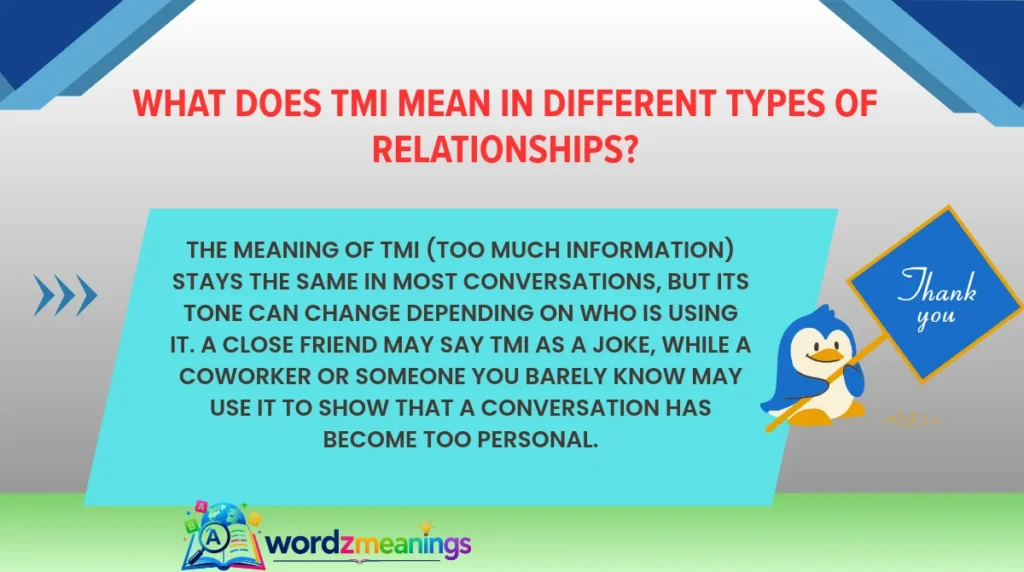
The meaning of TMI (Too Much Information) stays the same in most conversations, but its tone can change depending on who is using it. A close friend may say TMI as a joke, while a coworker or someone you barely know may use it to show that a conversation has become too personal. Understanding the relationship between the people involved can help you interpret the message correctly.
TMI Between Close Friends
Friends often share funny, embarrassing, or personal stories with each other. In these conversations, TMI is usually a playful reaction rather than a serious complaint.
For example:
Alex: “I accidentally sent a voice message while singing in the bathroom.”
Sam: “Bro, TMI 😂”
Sam may simply be teasing Alex. The laughing emoji makes the reply sound lighthearted, although the exact meaning still depends on their usual communication style.
TMI Between New Friends
When people have only recently met, they may not know each other’s comfort levels. Sharing private information too quickly can make a conversation awkward.
For example:
Person A: “I just met you yesterday, but let me explain every detail of my last breakup.”
Person B: “That might be a little TMI.”
Here, the response suggests that the information may be too personal for the current relationship. It does not necessarily mean the speaker dislikes the other person. They may simply prefer to get to know them gradually.
TMI Between Romantic Partners
Romantic partners often discuss personal matters that they would not share with other people. Therefore, information that might feel like TMI to a stranger may be completely normal between two people who trust each other.
However, being in a relationship does not mean that every topic is automatically comfortable for both partners.
For example:
“I care about you, but I don’t think I need all those details.”
This is a softer way to communicate discomfort without making the other person feel ashamed. Healthy conversations allow both people to express their boundaries.
TMI at School or Work
In school or professional settings, people usually expect conversations to stay relevant to the situation. Very personal stories may feel inappropriate when the group is discussing a class assignment, meeting, or work task.
For example:
“Let’s keep the discussion focused on the project. We probably don’t need those personal details.”
This communicates the same basic idea as TMI but sounds more professional.
TMI With Strangers Online
Online conversations can make it difficult to judge how comfortable another person feels. A stranger may not want to hear detailed information about someone’s health, relationships, family problems, or private experiences.
If someone responds with “TMI,” consider whether they are joking or asking you to stop. If their message sounds serious, acknowledge their reaction instead of continuing with more details.
The main takeaway: TMI does not automatically mean anger, disgust, or rejection. The relationship, topic, wording, and tone all help determine whether it is playful or a genuine request for more privacy.
How to Tell Someone They Are Oversharing Politely
You don’t always have to say “TMI.”
If the topic is sensitive, try a softer phrase:
- “You don’t have to go into that much detail.”
- “I get what you mean.”
- “You can keep the details private.”
- “I understand. No need to explain everything.”
- “I think I get the idea.”
These responses can protect someone’s feelings while still setting a boundary.
What Does “Snowbunny” Mean in Slang?
What Does FTP Mean in Texting and Online?
What Does “Bae” Mean in Texting and Social Media?
Frequently Asked Questions
What does TMI mean in slang?
TMI means “Too Much Information.” It is used when someone shares more personal, detailed, awkward, or unnecessary information than another person wants to hear.
What does TMI mean in texting?
In texting, TMI means Too Much Information. It is often used as a quick, humorous reaction to an overly personal message.
What does TMI mean on social media?
On social media, TMI usually means that someone has shared more personal or unnecessary information than the audience expected.
Is TMI a bad word?
No. TMI is not a swear word or inherently offensive expression. It is casual slang, although it can sound rude if used harshly.
Is TMI rude?
It can be. Among friends, “TMI 😂” is often playful. In a serious conversation, saying TMI may make someone feel embarrassed or dismissed.
What is the full form of TMI?
The full form of TMI is “Too Much Information.”
What does TMI mean from a girl?
If a girl says “TMI,” she usually means that you have shared more information than she wanted to hear. The meaning doesn’t change based on gender.
What does TMI mean from a guy?
If a guy says “TMI,” he usually means “Too Much Information.” He may be joking, teasing, or genuinely asking you not to share more details.
Does TMI mean oversharing?
Not exactly. TMI is the reaction to excessive information, while oversharing describes the act of giving too much personal information.
Can TMI be used jokingly?
Yes. In casual conversations, TMI is very often used as a joke.
What is the opposite of TMI?
There isn’t one fixed slang opposite. Depending on the situation, phrases such as “not enough information,” “give me the details,” or “tell me more” can express the opposite idea.
Conclusion
TMI means “Too Much Information.” It’s one of the easiest texting and internet slang abbreviations to understand. People use it when someone shares information that feels too personal, too detailed, embarrassing, unnecessary, or simply more than the listener wanted to hear.
The most important thing is to read the tone and context. Between close friends, “TMI 😂” may be nothing more than a joke.
In a serious conversation, however, it can be a clear request to stop sharing personal details.
If you’re unsure whether something might be TMI, a good rule is simple: share only the details that are useful, appropriate, and comfortable for the people involved.

I am Brandon Ellis, a language enthusiast and content writer at WordzMeanings. I create clear, accurate, and easy-to-understand explanations of words, phrases, and expressions to help readers improve their English every day.

2 thoughts on “TMI Meaning Slang: What Does “TMI” Mean? Updated 2026”