When someone says a person is “green” in a text, comment, or conversation, they may mean that the person is inexperienced, naive, or new to something.
The phrase is common in casual English and can describe someone who lacks experience.
Depending on context, “green” can also refer to jealousy, money, environmental ideas, or the color itself.
Quick Answer
| Term | Meaning |
|---|---|
| Green | Usually inexperienced, naive, or new to something |
| Full Form | No full form; it is an ordinary English word used as slang |
| Pronunciation | /ɡriːn/ — “green” |
| Category | Slang / informal expression |
| Tone | Usually casual; sometimes teasing or critical |
| Used On | Texting, social media, gaming, conversations, comments |
| Difficulty Level | Easy |
| One-line definition | “Green” can describe someone who is new, inexperienced, or not yet skilled at something. |
What Does Green Mean in Slang?
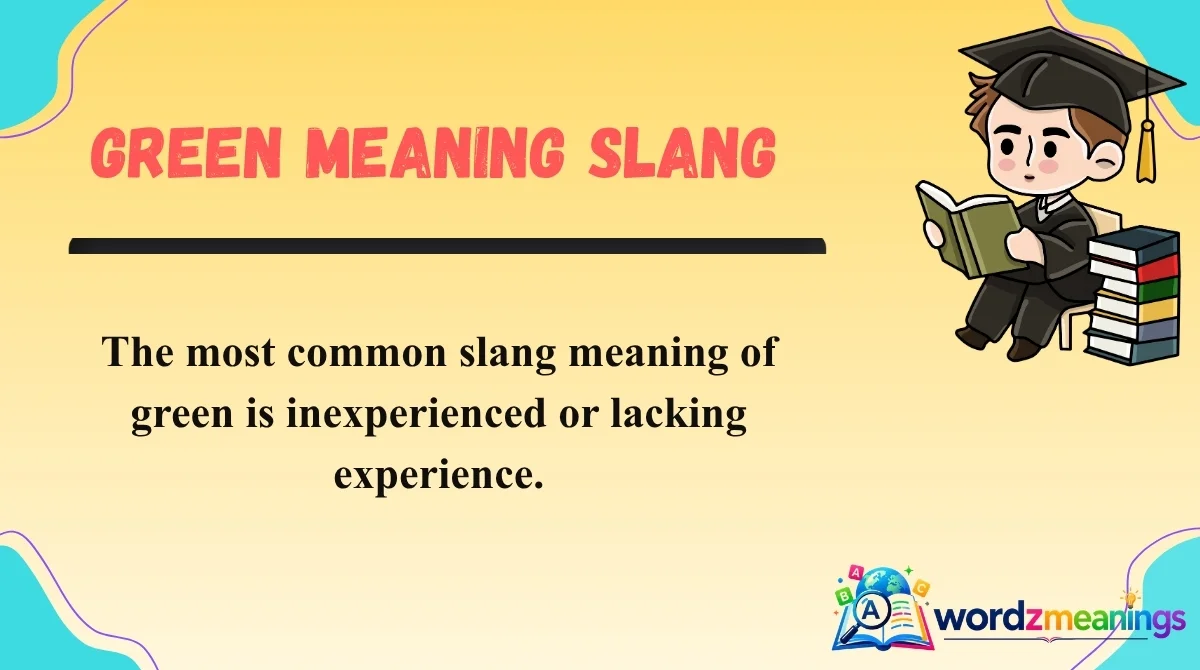
The most common slang meaning of green is inexperienced or lacking experience.
If someone calls another person “green,” they may be saying that the person is still learning and doesn’t know much about a particular situation.
For example:
“He’s still green at this job.”
This means:
“He’s still new and inexperienced at this job.”
The word doesn’t always mean that someone is unintelligent. In many cases, it simply means they haven’t had enough experience yet.
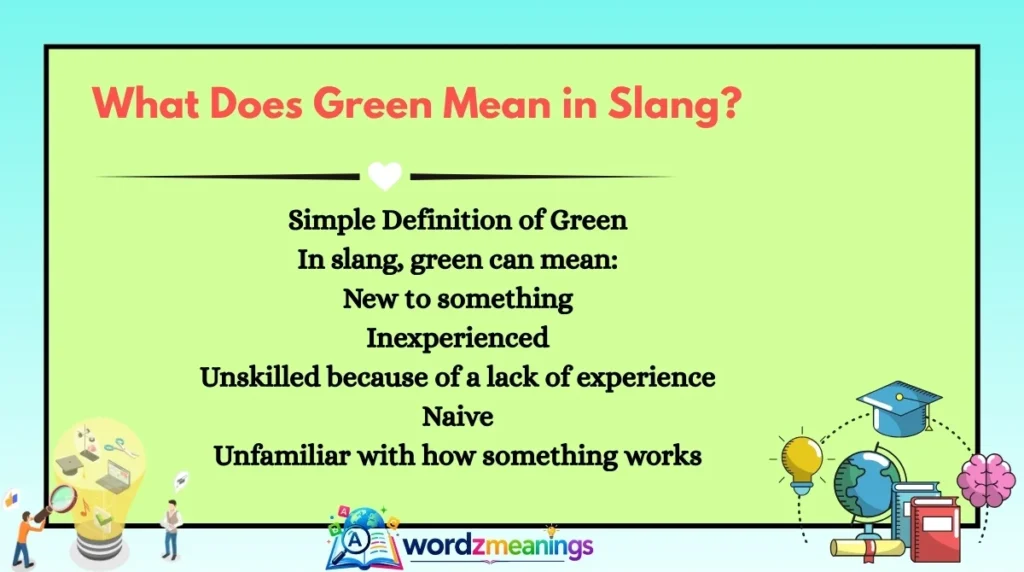
Simple Definition of Green
In slang, green can mean:
Green Meaning Slang
- New to something
- Inexperienced
- Unskilled because of a lack of experience
- Naive
- Unfamiliar with how something works
- Still learning
Why Do People Say Someone Is “Green”?
People often use green because it is a short and easy way to describe someone who is new or inexperienced.
Instead of saying:
“She doesn’t have much experience yet.”
Someone might simply say:
“She’s green.”
This is especially common when talking about jobs, sports, gaming, relationships, hobbies, or other situations where experience matters.
Example
“Don’t expect him to know everything. He’s green.”
Green Meaning Slang
Is “Green” a Bad Word?
No. Green is not automatically a bad word or offensive slang.
However, the tone can change its meaning.
If someone says:
“You’re a little green, but you’ll get better.”
That sounds supportive.
But if someone says:
“You’re so green. You don’t know anything.”
That can sound insulting or dismissive.
So, the word itself isn’t offensive. The context and tone matter.
Green Meaning in Different Contexts
The slang meaning of green isn’t always exactly the same. English speakers use the word in several informal ways.
Green Meaning Slang “Inexperienced”
This is one of the most important slang meanings.
Someone who is green may be new to a job, activity, sport, or situation.
Example:
“The new player is pretty green.”
Meaning:
The new player doesn’t have much experience yet.
Green Meaning Slang “Naive”
Sometimes green describes someone who is too trusting or doesn’t understand how people or situations really work.
Example:
“He’s too green to realize they’re taking advantage of him.”
Here, green is closer to naive than simply “new.”
Green Meaning Slang “New to a Job”
You may hear this word in workplaces, especially when talking about new employees.
Example:
“She’s green, but she’s learning quickly.”
This means the person is inexperienced but improving.
Green Meaning Slang “New to a Job” “New to a Skill”
The word can also describe someone who has just started learning something.
Example:
“I’m still green when it comes to coding.”
This means:
“I’m still inexperienced at coding.”
Green Meaning in Texting
In texting, green usually keeps its normal informal meaning.
If someone texts:
“He’s green.”
They may mean:
“He’s inexperienced.”
But you should look at the conversation before deciding what the person means.
For example:
Person A: “How’s your new teammate?”
Person B: “He’s green, but he’s got potential.”
Here, green clearly means inexperienced.
Another Texting Example
Person A: “Do you think she can handle the project?”
Person B: “Not yet. She’s still green.”
Green Meaning Slang “New to a Job”
Green Meaning on Social Media
On social media, green can have several meanings because people use it in different communities.
A comment such as:
“Bro is green 💀”
could mean that someone is inexperienced or doesn’t understand what’s happening.
However, social media slang changes quickly. Emojis, memes, and surrounding words can affect the meaning.
Example
“Bro is so green 😂”
This may be playful teasing.
It could mean:
“Bro has no experience.”
But if the same phrase appears in a serious discussion, the speaker may be criticizing the person’s lack of knowledge.
Green Meaning on TikTok
On TikTok, green can appear in jokes, comments, captions, and conversations about someone’s behavior.
When it describes a person, it can suggest that they are:
- Inexperienced
- Naive
- New to something
- Easily fooled
- Green Meaning Slang “New to a Job”
For example:
“He’s green to this whole thing.”
The meaning is roughly:
“He’s new to this and doesn’t understand it yet.”
TikTok slang can be highly context-dependent, so don’t assume that every use of “green” has the same meaning.
Green Meaning on Instagram
Green Meaning Slang
For example:
“She’s still green when it comes to relationships.”
Here, green means inexperienced.
Instagram users may also use “green” in completely different ways, such as talking about:
- The color green
- Nature
- Environmental topics
- Money
- Jealousy
That’s why the surrounding sentence is important.
Green Meaning on Snapchat
On Snapchat, “green” can be used casually in messages.
Example:
“I’m green at this game.”
This means:
“I’m new to this game.”
Another example:
“Don’t listen to him. He’s green.”
Green Meaning Slang
Green Meaning on WhatsApp
In WhatsApp chats, green can simply mean inexperienced or naive.
For example:
“I was pretty green when I started.”
This means:
“I didn’t have much experience when I started.”
WhatsApp conversations are usually informal, so the meaning often depends heavily on what the people were discussing.
Green Meaning in Gaming
Gaming is one context where green can make sense when talking about an inexperienced player.
Example:
“He’s green. Give him some time.”
Green Meaning Slang:
“He’s new to the game, so give him time to improve.”
A player might be called green because they:
- Just started playing
- Don’t know the game mechanics
- Make beginner mistakes
- Don’t understand advanced strategies
- Green Meaning Slang
Gaming Conversation
Player 1: “Why did he make that move?”
Player 2: “He’s green.”
Player 1: “Oh, he’s new?”
Player 2: “Yeah, this is only his second match.”
Here, green means inexperienced.
Green Meaning at Work
At work, calling someone green usually means they are new or inexperienced.
For example:
“He’s a green employee.”
Green Meaning Slang
“He’s an inexperienced employee.”
A more natural version in everyday conversation might be:
“He’s still green.”
Is Calling a Coworker Green Professional?
Green Meaning Slang
In a casual workplace conversation, it may be understood easily. But in formal communication, terms such as new, inexperienced, or still learning are usually safer.
Instead of:
“She’s very green.”
A professional alternative is:
“She’s new to the role and still gaining experience.”
Green Meaning Slang
Green Meaning in Relationships
In relationship conversations, green can mean inexperienced or naive.
For example:
“I was green when I started dating.”
This means:
“I didn’t have much dating experience.”
Someone might also say:
“He’s green when it comes to relationships.”
Green Meaning Slang
However, green isn’t normally a specific dating abbreviation or a universal romantic code. The context matters.
Is “Green” Flirty?
Usually, green is not inherently flirty.
If someone calls you “green,” they are generally talking about your experience, knowledge, or behavior.
For example:
“You’re so green.”
Green Meaning Slang
A romantic or playful conversation could give the phrase a different tone, but you shouldn’t assume “green” is flirting without other clues.
Green Meaning “Jealous”
Another important meaning comes from the expression green with envy.
Here, green is connected with jealousy or envy.
Example:
“He was green with envy when he saw her new car.”
Green Meaning Slang:
“He was very jealous when he saw her new car.”
This is different from calling someone green because they’re inexperienced.
Green vs Green With Envy
| Expression | Meaning |
|---|---|
| He’s green. | He’s inexperienced or naive. |
| She’s green at the job. | She’s inexperienced at the job. |
| He’s green with envy. | He’s extremely jealous. |
| I’m green at gaming. | I’m inexperienced at gaming. |
The phrase green with envy is an established English expression, while green by itself often means inexperienced when used as slang.
Green Meaning Money
In some informal contexts, green can refer to money.
This comes from the traditional green color associated with U.S. paper currency.
For example:
“He’s chasing the green.”
Depending on context, this can mean:
“He’s chasing money.”
You shouldn’t automatically interpret every use of “green” as money. The surrounding words usually make the intended meaning clear.
Example
“It’s all about the green for him.”
Green Meaning Slang
Green Meaning Environmental or Eco-Friendly
Green can also describe environmental ideas, products, lifestyles, or policies.
For example:
“They’re trying to go green.”
This means:
“They’re trying to live or operate in a more environmentally friendly way.”
Examples include:
- Reducing waste
- Saving energy
- Recycling
- Green Meaning Slang
- Reducing pollution
This is not exactly slang, but it is an important modern use of the word.
Green Meaning the Color
Sometimes green simply means green.
This sounds obvious, but it’s important because slang explanations can sometimes make ordinary words seem like slang everywhere.
For example:
“I bought a green shirt.”
There is no slang meaning here.
The word simply describes a color.
Always check the sentence before assuming that green is being used as slang.
Green Meaning: Inexperienced vs Naive
Green Meaning Slang
Inexperienced means someone hasn’t had much practice or exposure.
Naive means someone may lack understanding or judgment, often because they haven’t experienced enough of the real world.
Comparison
| Word | Main idea |
|---|---|
| Green | Inexperienced or new |
| Naive | Lacking worldly understanding |
| Beginner | Someone who has just started |
| Novice | Someone with little experience |
| Unskilled | Someone who lacks skill |
| Newbie | Someone new to a community or activity |
For example:
“He’s green at basketball.”
This mainly means he lacks experience.
But:
“He’s naive about people.”
Green Meaning Slang
Green vs Newbie
Green and newbie can overlap, but they aren’t exactly the same.
A newbie is usually someone who is new to a particular activity or community.
A green person is someone who lacks experience or understanding.
Example:
“He’s a newbie.”
Green Meaning Slang
“He’s green.”
This suggests the person is inexperienced, but it doesn’t necessarily mean they have just started.
Green vs Beginner
A beginner is someone at an early stage of learning.
Green is more informal.
For example:
“I’m a beginner at tennis.”
Green Meaning Slang
“I’m pretty green at tennis.”
This is casual and conversational.
Green Meaning Slang
Green vs Inexperienced
Inexperienced is the direct and neutral word.
Green is more informal and can sometimes carry extra ideas such as being naive or unprepared.
| Expression | Tone |
|---|---|
| Inexperienced | Neutral/formal |
| Green | Informal |
| Beginner | Neutral |
| Newbie | Casual |
| Novice | Neutral/formal |
| Naive | Can sound critical |
Is “Green” Insulting?
Green Meaning Slang
The word becomes insulting when it is used to put someone down for not knowing something.
For example:
“You’re green. You clearly don’t know what you’re doing.”
That sounds harsh.
Green Meaning Slang
“You’re still green, but you’ll learn.”
That sounds encouraging.
What Makes the Difference?
The tone depends on:
- The speaker’s attitude
- The relationship between the people
- The situation
- The words around “green”
- Green Meaning Slang
When Should You Use “Green”?
You can use green in casual conversations when you want to say that someone is inexperienced.
For example:
“I’m still green at this.”
“He’s green, so give him a chance.”
“She was pretty green when she started.”
These sound natural in informal English.
When Should You Avoid “Green”?
Avoid it when the situation requires very formal or precise language.
For example, in a formal report, instead of:
“The employee is green.”
Use:
“The employee is new to the role and is still gaining experience.”
This removes ambiguity and sounds more professional.
Common Mistakes With “Green”
Mistake 1: Thinking Green Always Means Inexperienced
Not every use of green has the slang meaning.
It can also refer to:
- A color
- Money
- Jealousy
- Environmental issues
- Nature
Always check the context.
Mistake 2: Assuming It Means Stupid
Calling someone green does not automatically mean they are stupid.
It usually means they don’t have enough experience.
A person can be highly intelligent and still be green at something they’ve never done before.
Mistake 3: Assuming It Is Always an Insult
The speaker may simply be describing someone’s experience level.
For example:
“She’s green, but she’s learning fast.”
That’s not necessarily an insult.
Mistake 4: Assuming It Is Flirty
“Green” isn’t automatically romantic or flirty.
If someone uses it in a romantic conversation, look at the rest of the message before interpreting it.
How to Reply When Someone Calls You “Green”
Your response depends on the tone.
If They’re Being Friendly
You could say:
“Yeah, I’m still learning.”
Or:
“True. Give me some time.”
If They’re Teasing You
You could respond playfully:
“Everyone starts somewhere.”
Or:
“I’ll get there.”
If They’re Being Rude
You can stay calm:
“I may be new, but I’m learning.”
This shows confidence without turning the conversation into an argument.
Green Meaning in Different Situations
| Situation | Possible meaning |
|---|---|
| New employee | Inexperienced |
| Gaming | New or inexperienced player |
| Sports | Inexperienced athlete |
| Dating | Little romantic experience |
| Texting | Usually inexperienced or naive |
| Social media | Often inexperienced, but context matters |
| “Green with envy” | Jealous |
| Money | Money/cash in some contexts |
| “Go green” | Environmentally friendly |
| Clothing | Literally the color green |
Natural Conversation Examples
Example 1: New Job
Alex: “How’s the new guy?”
Sam: “He’s pretty green.”
Meaning: Sam means the new employee doesn’t have much experience yet.
Example 2: Gaming
Alex: “Why doesn’t he know that strategy?”
Sam: “He’s green. It’s his first week.”
Meaning: The player is new and still learning the game.
Example 3: Supportive Use
Alex: “I don’t think I’m good enough.”
Sam: “You’re just green. Keep practicing.”
Meaning: Sam is saying that the person needs more experience, not that they lack ability.
Example 4: Naive Use
Alex: “He gave his password to a stranger.”
Sam: “He’s really green.”
Meaning: Here, green suggests that the person is naive or inexperienced.
Example 5: Jealousy
Alex: “Did you see her new car?”
Sam: “Yeah. Mike was green with envy.”
Meaning: Mike was very jealous.
Frequently Asked Questions
What does green mean in slang?
In slang, green commonly means inexperienced, new, or naive. It can describe someone who hasn’t had much practice or doesn’t yet understand a particular situation.
What does it mean when someone calls you green?
It usually means they think you’re inexperienced or new to something. Depending on their tone, it can be friendly advice, simple description, teasing, or an insult.
Is green slang for inexperienced?
Yes. Green is commonly used informally to describe someone who lacks experience.
Does green mean naive?
It can. In some contexts, green suggests that someone is inexperienced and therefore easily confused, fooled, or overly trusting.
Is calling someone green rude?
Not necessarily. The phrase can be neutral or friendly, but it can sound rude if the speaker uses it to mock someone’s lack of knowledge.
Does green mean beginner?
It can be similar to beginner, but green focuses more on a lack of experience. A beginner is usually someone who has just started learning something.
What does green mean in texting?
In texting, green can mean inexperienced or naive when it is used to describe a person. The exact meaning depends on the conversation.
What does green mean on TikTok?
On TikTok, green can describe someone as inexperienced or naive, especially in jokes and comments. However, social media context can change the meaning.
What does green mean in gaming?
In gaming, green can describe a player who is new or inexperienced and still learning the game.
Is green a bad word?
No. Green is not a swear word or inherently offensive term. Its tone depends on how it is used.
Does green mean jealous?
It can, especially in the expression “green with envy,” which means very jealous.
Does green mean money?
In some informal contexts, green can refer to money, especially U.S. currency. Context is necessary to know whether money is intended.
Does green mean environmentally friendly?
Yes. In phrases such as “go green,” green refers to environmentally friendly behavior or practices.
What is the opposite of green slang?
Depending on the context, possible opposites include:
- Experienced
- Skilled
- Seasoned
- Knowledgeable
- Advanced
- Veteran
For example:
“He’s green.”
Opposite:
“He’s seasoned.”
Conclusion
The most common green meaning slang is inexperienced, new, or naive. If someone says, “You’re green,” they usually mean you don’t have much experience with the situation.
But context matters. Green can also relate to jealousy in “green with envy,” money in some informal expressions, environmental issues in “go green,” or simply the color green.
The safest way to understand the word is to look at the full sentence. If it describes a person’s ability or experience, green probably means inexperienced or naive.
If it appears with words like “envy,” “money,” or “environment,” the intended meaning may be completely different.

I am Brandon Ellis, a language enthusiast and content writer at WordzMeanings. I create clear, accurate, and easy-to-understand explanations of words, phrases, and expressions to help readers improve their English every day.