
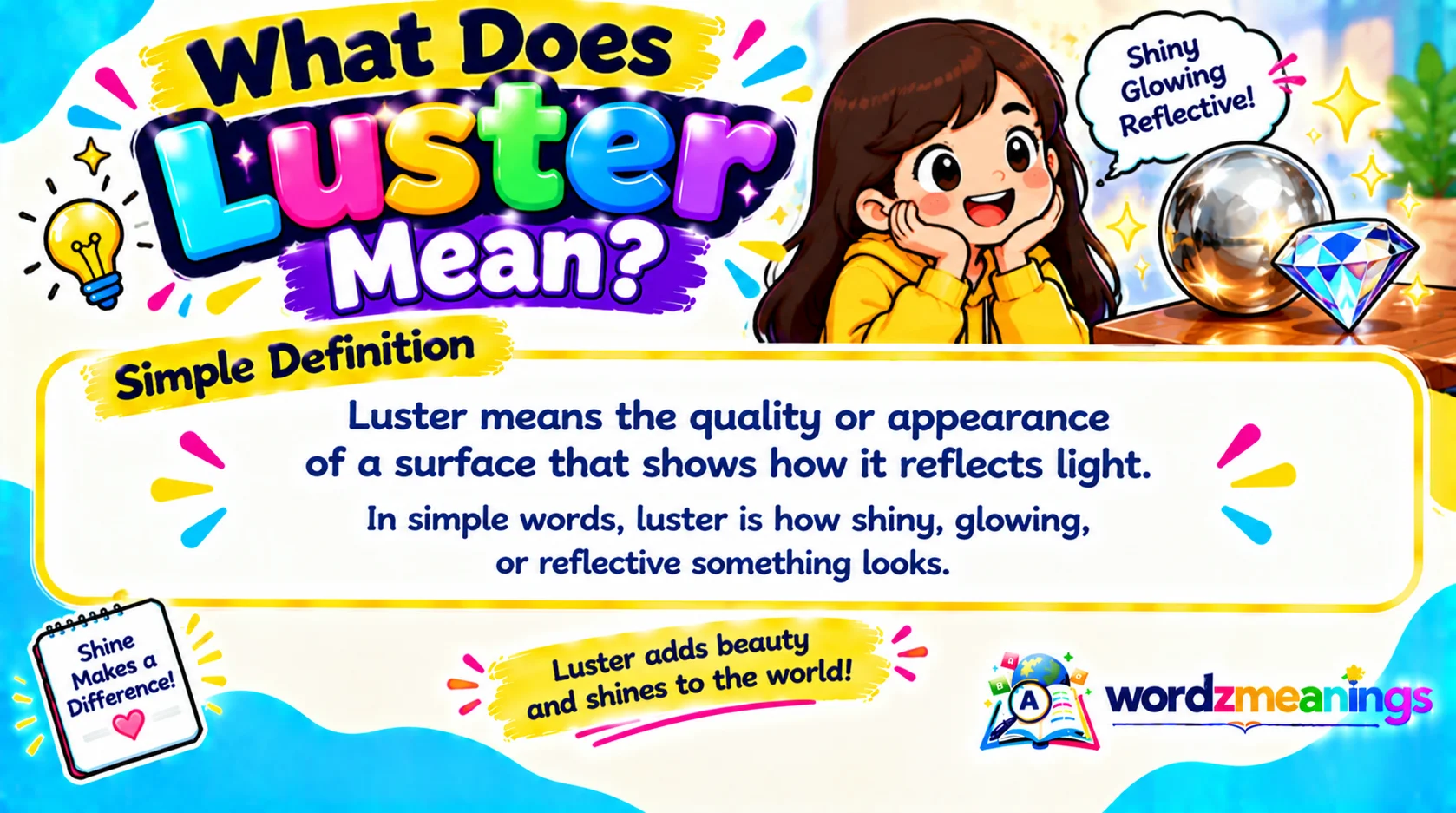
When people ask what does luster mean, they usually want to know what the word means when describing how something looks. Luster means the shine, glow, or soft reflection seen on the surface of an object.
You may see it used for hair, skin, fabric, paint, metals, minerals, jewelry, and other things.
The word can describe a bright shine, a gentle glow, or the way light reflects from a surface.
Understanding what does luster mean can help you understand descriptions in books, product reviews, science lessons, beauty content, and everyday conversations.
What Does Luster Mean?
Simple Definition of Luster
Luster means the quality or appearance of a surface that shows how it reflects light.
In simple words, luster is how shiny, glowing, or reflective something looks.
For example:
- Clean silver has a bright luster.
- Healthy hair can have a natural luster.
- Silk has a soft, smooth luster.
- A polished stone may have a strong luster.
- Old metal may lose its luster over time.
The exact meaning can change slightly depending on the context.
What Is the Meaning of Luster in Simple Words?
Easy Explanation
Luster is the shine or glow that something has.
If something reflects light in an attractive way, you can say it has luster.
For example:
“The necklace has a beautiful luster.”
This means the necklace has an attractive shine or glow.
Another example is:
“Her hair has a natural luster.”
Here, luster means the hair looks naturally shiny and healthy.
What Does Luster Mean in Different Contexts?
Luster in Everyday English
In everyday English, luster often means shine, brightness, or attractiveness.
Someone might say:
“The table has lost its luster.”
This can mean that the table no longer looks as shiny as it once did.
The word can also be used in a more figurative way. A person, event, achievement, or reputation can “lose its luster” when it becomes less exciting, impressive, or attractive.
Luster in Science
In science, especially when studying minerals, luster has a more specific meaning.
It describes the way light interacts with and reflects from the surface of a mineral.
Scientists and students may describe mineral luster as:
- Metallic
- Glassy
- Pearly
- Silky
- Resinous
- Waxy
- Dull or earthy
For example, a mineral that looks like polished metal may be described as having a metallic luster.
Luster in Beauty
In beauty and personal care, luster usually refers to a healthy-looking shine.
For example:
“This conditioner helps restore hair luster.”
Here, luster means the smooth, shiny appearance of the hair.
You may also see phrases such as:
- Hair luster
- Natural luster
- Skin luster
- Shiny appearance
- Restored luster
Luster in Jewelry
Luster is also commonly used when talking about jewelry and gemstones.
A polished gemstone can reflect light from its surface, creating an attractive appearance.
For example:
“The gemstone has a bright luster.”
This tells the reader that the stone has a noticeable shine or reflective quality.
What Does Luster Mean in a Sentence?
Example 1
“The polished floor had a beautiful luster.”
Explanation: The floor looked shiny because its surface reflected light.
Example 2
“The fabric had a soft luster.”
Explanation: The fabric had a gentle shine rather than a very bright reflection.
Example 3
“The old furniture had lost its luster.”
Explanation: The furniture no longer looked as shiny or attractive as before.
Example 4
“The stone has a metallic luster.”
Explanation: The stone’s surface looks similar to metal when it reflects light.
Example 5
“Her hair had a healthy luster.”
Explanation: Her hair looked naturally smooth and shiny.
What Does Luster Mean in Everyday Conversation?
How People Use the Word
Luster is not usually a slang word. It is a standard English noun.
People may use it when they want to describe the appearance or shine of something.
For example:
“The new paint gave the room more luster.”
This means the new paint made the room look brighter or more attractive.
The word can also describe something that has become less impressive:
“The award has lost some of its luster.”
This does not mean the award physically became less shiny. It means the award has become less exciting, valuable, or impressive in someone’s eyes.
What Does “Lose Its Luster” Mean?
Literal Meaning
Literally, lose its luster means to lose its shine or brightness.
For example:
“The silver lost its luster after years of use.”
The silver is no longer as shiny as it was before.
Figurative Meaning
The phrase can also have a figurative meaning.
“Lose its luster” means to become less attractive, exciting, impressive, or desirable.
For example:
“The job started to lose its luster after several difficult months.”
This means the job no longer seemed as appealing as it did at first.
What Does “Restore Its Luster” Mean?
Simple Meaning
Restore its luster means to bring back something’s shine, beauty, appeal, or attractiveness.
For physical objects:
“Polishing the silver restored its luster.”
The polishing brought back the silver’s shine.
For figurative use:
“The victory restored the team’s luster.”
Here, luster means reputation, excitement, or prestige rather than physical shine.
What Does Luster Mean in Writing?
Describing Physical Appearance
Writers often use luster to make descriptions more vivid.
Instead of saying:
“The metal was shiny.”
A writer might say:
“The metal had a bright luster.”
Both sentences describe shine, but luster can sound more precise or descriptive.
Describing Beauty
The word can also make descriptions of hair, fabric, jewelry, and other surfaces more detailed.
For example:
“The silk caught the light with a soft luster.”
This creates a picture of fabric that gently reflects light.
Luster vs. Shine
Are Luster and Shine the Same?
Luster and shine are closely related, but they aren’t always identical.
Shine is a common everyday word for brightness or reflected light.
Luster often describes the particular quality or appearance of that reflection.
| Word | Basic Meaning | Common Use |
|---|---|---|
| Shine | Brightness or reflected light | Everyday English |
| Luster | Quality or appearance of reflected light | Objects, beauty, minerals, writing |
| Gloss | Smooth, shiny surface appearance | Paint, paper, hair, finishes |
| Glow | Soft or warm-looking light | Skin, lights, objects, emotions |
Example
“The car has a nice shine.”
This is simple and everyday.
“The car’s paint has a deep luster.”
This focuses more on the quality and appearance of the surface.
Luster vs. Gloss
What Is the Difference?
Gloss usually describes a smooth and shiny surface or finish.
Luster is broader and can describe different types of surface appearance caused by reflected light.
For example:
- Glossy paint has a strong smooth reflection.
- A pearl can have a soft luster.
- A mineral can have a metallic luster.
- Hair can have a natural luster.
So, something can have luster without having a highly glossy surface.
Luster vs. Glow
How Are They Different?
A glow usually suggests soft light or brightness that seems to come from something.
Luster usually refers to the way light reflects from a surface.
For example:
“The lamp gave the room a warm glow.”
The lamp produces light.
But:
“The polished stone had a soft luster.”
The stone is reflecting light from its surface.
Is Luster a Positive Word?
Usually, Yes
Luster is often used positively when describing beauty, quality, or shine.
For example:
“The jewelry has a beautiful luster.”
This suggests that the jewelry looks attractive.
However, the word can also be neutral.
For example:
“The mineral has a metallic luster.”
This is simply describing its physical appearance.
It can also appear in negative expressions:
“The surface has lost its luster.”
This suggests that the surface is less shiny or attractive than before.
Is Luster a Noun?
Yes
Luster is a noun.
It names a quality or appearance.
Examples:
“The stone has a natural luster.”
“The fabric’s luster makes it look expensive.”
“The metal lost its luster.”
The related adjective lustrous means shiny, glowing, or attractive.
For example:
“The fabric has a lustrous appearance.”
What Does Lustrous Mean?
Simple Definition
Lustrous means having a noticeable shine, glow, or attractive surface appearance.
Examples:
“She had lustrous hair.”
“The vase had a lustrous finish.”
“The mineral appeared lustrous under the light.”
In each example, lustrous describes something that looks shiny or radiant.
Luster and Lustrous: What’s the Difference?
Luster
Luster is a noun.
“The stone has a beautiful luster.”
Lustrous
Lustrous is an adjective.
“The stone has a lustrous surface.”
A simple way to remember it:
Luster = the shine or quality
Lustrous = having that shine or quality
What Are the Types of Luster?
Metallic Luster
Metallic luster makes a surface look similar to polished metal.
It is often used when describing minerals.
Glassy or Vitreous Luster
A glassy luster resembles the appearance of glass.
It can look smooth and bright when light reflects from the surface.
Pearly Luster
Pearly luster has a soft appearance similar to the surface of a pearl.
It is less harsh than a strong metallic reflection.
Silky Luster
Silky luster gives a material a smooth, thread-like or silk-like shine.
It is often associated with surfaces that have fine fibers or structures.
Waxy Luster
Waxy luster looks similar to wax.
It usually appears softer and less reflective than a highly polished surface.
Resinous Luster
Resinous luster resembles the appearance of resin.
It can have a warm, somewhat glossy surface appearance.
Dull or Earthy Luster
A dull or earthy surface reflects very little light.
It may look flat rather than shiny.
Why Does Luster Matter?
It Helps Describe Surfaces
What Does Luster Mean
Instead of simply saying something is “shiny,” luster can give a clearer idea of the type and quality of the reflection.
It Helps Identify Minerals
In mineral study, luster is one of the properties used to describe and identify minerals.
However, luster is normally considered together with other properties rather than being the only clue.
It Helps Describe Beauty and Quality
In everyday writing, luster can describe the attractive appearance of hair, jewelry, fabric, furniture, paint, and other materials.
Common Phrases With Luster
Lose Its Luster
Means to become less shiny, attractive, exciting, or impressive.
Restore Its Luster
Means to bring back shine, beauty, appeal, or prestige.
Natural Luster
Means the natural shine or reflective quality of something.
Soft Luster
Means a gentle or subtle shine.
Bright Luster
Means a strong or noticeable shine.
Metallic Luster
Means a surface appearance similar to metal.
Lustrous Surface
Means a surface that looks shiny or radiant.
Common Mistakes With the Word Luster
Mistake 1: Thinking Luster Only Means “Very Shiny”
Luster does not always mean an extremely bright shine.
A surface can have a soft, pearly, silky, waxy, or dull luster.
Mistake 2: Using Luster Only for Objects
Luster can describe physical surfaces, but it can also be used figuratively.
For example:
“The company lost its luster.”
Here, the word refers to reputation or appeal.
Mistake 3: Confusing Luster With Light
Luster isn’t simply light itself.
It describes the appearance produced when light interacts with a surface.
Mistake 4: Confusing Luster With Lust
Luster and lust are different words.
Luster relates to shine, appearance, or appeal.
Lust generally refers to a strong desire, especially sexual desire.
What Is the Opposite of Luster?
Physical Opposites
Depending on the context, possible opposites include:
- Dullness
- Flatness
- Lack of shine
- Opacity
- Matteness
For example:
“The metal changed from a bright luster to a dull surface.”
Figurative Opposites
When luster means appeal or prestige, possible opposites include:
- Dullness
- Unattractiveness
- Lack of appeal
- Disrepute
The best opposite depends on how the word is being used.
What Are Synonyms for Luster?
Common Synonyms
Depending on the context, synonyms may include:
- Shine
- Sheen
- Gloss
- Gleam
- Radiance
- Brightness
- Sparkle
- Glow
- Polish
- Appeal
- Prestige
These words are not perfect replacements in every sentence.
For example, sheen often describes a soft surface shine, while prestige fits the figurative meaning of luster.
What Does Luster Mean in a Book or Story?
Literary Use
In literature, luster can describe the physical appearance of something.
For example:
“The moonlight gave the lake a silver luster.”
Here, luster creates a visual image of reflected light.
Writers can also use the word figuratively:
“The old tradition had lost its luster.”
This means the tradition no longer seemed as exciting, meaningful, or impressive as it once did.
What Does Luster Mean in School?
English Class
In English class, students may encounter luster when reading descriptive or literary writing.
The word usually refers to shine, brightness, beauty, or appeal.
Science Class
In science, especially geology, students may learn luster as a property used to describe minerals.
A teacher might ask:
“What type of luster does this mineral have?”
The answer could be metallic, glassy, pearly, silky, waxy, or another descriptive type.
What Does Luster Mean in a Product Description?
Clothing and Fabric
A product description might say:
“The fabric has a subtle luster.”
This means the material has a gentle shine that can make it look smooth or refined.
Jewelry
A jewelry description might say:
“The stone has a brilliant luster.”
This points to the stone’s attractive surface reflection.
Hair Products
A hair product may promise:
“Adds luster to dull hair.”
This means it is intended to make hair appear shinier.
What Does Luster Mean in a Sentence for Kids?
Easy Examples
“The shiny coin had a bright luster.”
What Does Luster Mean: The coin looked shiny.
“The pearl had a soft luster.”
What Does Luster Mean: The pearl had a gentle shine.
“The old car lost its luster.”
What Does Luster Mean: The car no longer looked as shiny or attractive.
“The mineral has a metallic luster.”
What Does Luster Mean: The mineral looks like metal when it reflects light.
Frequently Asked Questions
What does luster mean in simple words?
Luster means the shine, glow, or reflective quality of a surface.
What is an example of luster?
A polished piece of silver has luster because its surface reflects light and looks shiny.
Is luster the same as shine?
They are closely related. Shine is a common word for reflected brightness, while luster describes the quality or appearance of that reflection.
What does it mean when something loses its luster?
It can mean that something loses its physical shine or, figuratively, becomes less attractive, exciting, impressive, or valuable.
What does lustrous mean?
Lustrous means shiny, radiant, or attractive in appearance.
Is luster a noun or adjective?
Luster is a noun. The adjective form is lustrous.
What is the opposite of luster?
For physical appearance, common opposites include dullness and lack of shine. The best opposite depends on the context.
What does luster mean in minerals?
In mineralogy, luster describes how a mineral’s surface reflects light.
Can luster describe hair?
Yes. Hair luster means the natural-looking shine or reflective quality of hair.
Can luster have a figurative meaning?
Yes. It can describe appeal, excitement, prestige, or attractiveness rather than physical shine.
Conclusion
Luster means the quality or appearance of shine or reflected light from a surface. It can describe minerals, metals, jewelry, hair, fabric, paint, and many other materials.
In phrases such as “lose its luster,” the meaning can become figurative, referring to something becoming less attractive, exciting, or impressive.
A simple way to remember what does luster mean is:
Luster = shine, glow, or the attractive quality created by reflected light.

I am Brandon Ellis, a language enthusiast and content writer at WordzMeanings. I create clear, accurate, and easy-to-understand explanations of words, phrases, and expressions to help readers improve their English every day.



