If you’re wondering what does Adam mean, the name Adam is traditionally understood to mean “man,” “human,” or “humankind.”
It is a very old name with roots in Hebrew and is closely connected with the biblical story of Adam, the first human in the Book of Genesis.
Today, Adam is still widely used as a personal name across many cultures.
What Does Adam Mean?
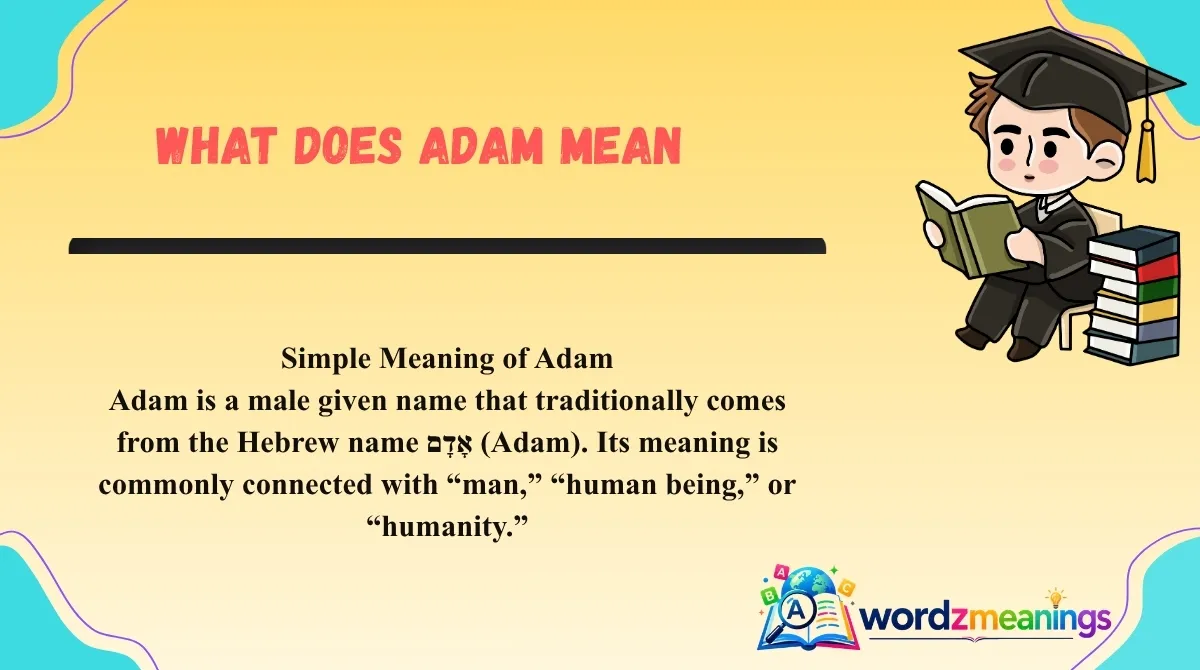
Simple Meaning of Adam
Adam is a male given name that traditionally comes from the Hebrew name אָדָם (Adam). Its meaning is commonly connected with “man,” “human being,” or “humanity.”
The name also has a close linguistic connection with the Hebrew word adamah, meaning “ground” or “earth.” This connection is important because the biblical story describes the first human as being formed from the earth.
So, depending on the context, Adam can carry ideas of:
- Man
- Human being
- Humanity
- Earth
- Being formed from the ground
Quick Answer
| Detail | Answer |
|---|---|
| Meaning | Man, human, or humanity |
| Origin | Hebrew |
| Hebrew form | אָדָם (Adam) |
| Pronunciation | AD-əm |
| Category | Male given name |
| Tone | Traditional, familiar, classic |
| Used On | Names, religion, literature, everyday conversation |
| Difficulty Level | Easy |
| One-line definition | Adam is an ancient male name commonly associated with “man” or “humanity.” |
Where Does the Name Adam Come From?
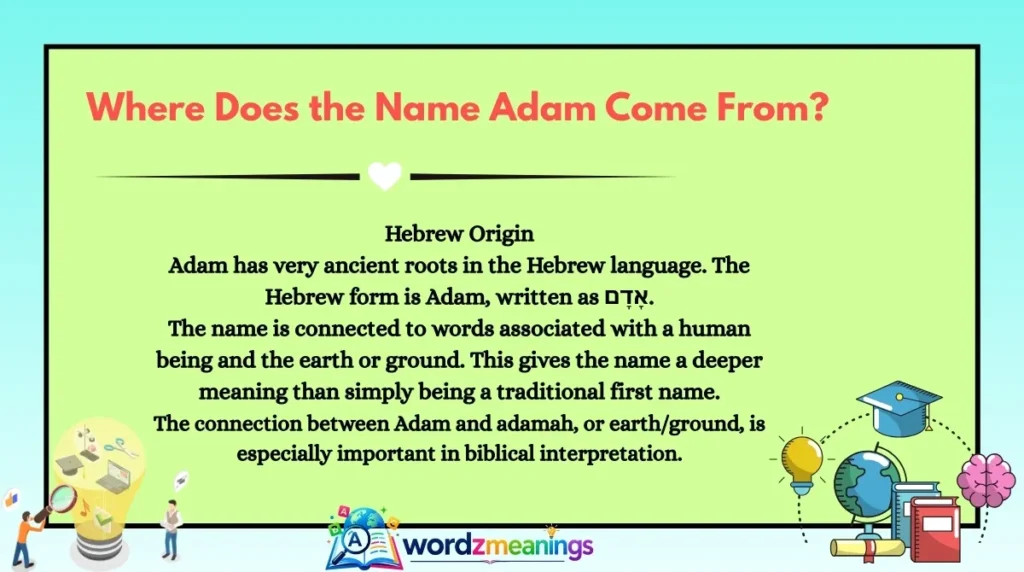
Hebrew Origin
Adam has very ancient roots in the Hebrew language. The Hebrew form is Adam, written as אָדָם.
The name is connected to words associated with a human being and the earth or ground. This gives the name a deeper meaning than simply being a traditional first name.
The connection between Adam and adamah, or earth/ground, is especially important in biblical interpretation.
Adam in the Bible
In the Book of Genesis, Adam is presented as the first human created by God.
The story says that God formed Adam from the dust of the ground and gave him life. Adam is then placed in the Garden of Eden.
Because of this story, the name Adam became strongly associated with:
- The first human
- Creation
- Humanity
- The beginning of human life
- The relationship between humans and the earth
This biblical connection is one of the main reasons the name has remained important for thousands of years.
What Does Adam Mean in the Bible?
Adam as the First Human
In the biblical creation story, Adam is the first human.
The name therefore has a strong connection with humanity itself. When people encounter the name in a religious context, they may immediately think of the first man in Genesis.
Adam’s story also includes Eve, who is traditionally described as the first woman.
Adam and Eve
Adam and Eve are among the best-known figures in the Bible.
Their story is associated with the Garden of Eden, the forbidden fruit, temptation, disobedience, and the beginning of humanity’s life outside Eden.
Because of this, the name Adam can have a strong religious or historical feeling even when it is simply being used as someone’s first name.
What Does Adam Mean in Islam?
Adam in Islamic Tradition
Adam is also an important figure in Islam.
In Islamic tradition, Adam (Ādam) is regarded as the first human and a prophet of God. His story appears in the Qur’an and Islamic tradition.
The Islamic understanding of Adam shares some broad elements with the biblical account, including his creation and his presence in the Garden.
However, Islamic teachings have their own details and theological interpretations, so the biblical and Islamic accounts should not simply be treated as identical.
Why Adam Is Important in Islam
The name Adam has a strong religious connection for Muslims because Prophet Adam is considered the first human and an important prophet.
For this reason, Adam is a popular and meaningful name in many Muslim communities.
Is Adam a Popular Name?
Adam as an International Name
Adam is one of those names that has traveled across languages, religions, and cultures.
It is commonly recognized in many parts of the world, including communities influenced by:
- Judaism
- Christianity
- Islam
- Hebrew culture
- Arabic culture
- European naming traditions
Although pronunciation can vary slightly between languages, the basic form remains recognizable.
Why Parents Choose the Name Adam
Parents may choose Adam because it is:
- Easy to pronounce
- Easy to spell
- Historically important
- Recognized in many countries
- Connected to religious traditions
- Traditional without sounding unusual
For some families, the religious meaning matters most. For others, the name is simply familiar and timeless.
What Does the Name Adam Symbolize?
Humanity
One of the strongest symbolic ideas connected with Adam is humanity.
Since Adam is traditionally described as the first human, the name can represent human life as a whole.
Creation
Adam is also strongly associated with creation.
The biblical and Islamic traditions both connect Adam with the beginning of human existence, although the details and interpretations differ.
Earth and Ground
The connection between Adam and adamah, meaning earth or ground, adds another layer of symbolism.
It can suggest a connection between human beings and the natural world.
Beginning
Adam can also symbolize a beginning because of his traditional role as the first human.
This is more of a symbolic interpretation than a direct dictionary definition, but it helps explain why the name carries such a strong historical feeling.
Is Adam a Boy’s Name?
Adam as a Male Name
Yes. Adam is traditionally a masculine or male given name.
It is commonly given to boys and is recognized as a male name in many cultures.
For example:
“Adam is starting school this year.”
Here, Adam is simply being used as a person’s name.
How Do You Pronounce Adam?
Common Pronunciation
In English, Adam is usually pronounced:
AD-əm
The first syllable sounds like “ad”, followed by a softer second syllable.
Pronunciation Can Vary
The pronunciation may change slightly depending on the language or accent.
For example, the Arabic form Ādam may sound somewhat different from the common English pronunciation, even though the name is recognizable as the same traditional name.
Is Adam a Biblical Name?
Yes, Adam Is a Biblical Name
Adam is one of the most recognizable biblical names.
He appears in the Book of Genesis and is traditionally described as the first human created by God.
The name therefore has a much older history than many modern first names.
Adam in Genesis
The story of Adam is connected with several major themes:
- Creation
- The Garden of Eden
- Eve
- The forbidden fruit
- Human responsibility
- Disobedience
- Life outside Eden
Because the story is so well known, Adam has become a familiar name even among people who do not use it for religious reasons.
What Does Adam Mean in Arabic?
Adam in Arabic
In Arabic, the name is commonly written:
آدم
It is pronounced approximately Ādam.
Adam is an important name in Arabic-speaking Muslim communities because Ādam is the name of the first human and a prophet in Islamic tradition.
Does Adam Have the Same Meaning in Arabic?
The name has a long-standing connection with the concept of the human being and with Adam’s traditional role as the first human.
However, meanings given to ancient names can depend on linguistic tradition and interpretation, so it is better not to reduce the name to only one modern English translation.
Is Adam a Religious Name?
It Can Be Religious or Non-Religious
Adam has strong religious associations, but a person named Adam does not necessarily use the name for religious reasons.
Someone may be named Adam because:
- Their parents are religious.
- Their family follows a naming tradition.
- They like the name.
- It is common in their culture.
- They simply prefer its sound.
So, Adam is a religiously significant name, but it is not exclusively a religious name.
What Does Adam Mean as a Baby Name?
Meaning for Parents
As a baby name, Adam often appeals to parents who want a name that feels classic, simple, and meaningful.
Its long history gives it a traditional quality, while its short spelling makes it easy to use in everyday life.
Baby Name Associations
When parents choose Adam, they may associate the name with:
- Humanity
- Creation
- Tradition
- Faith
- History
- Simplicity
These are associations rather than additional dictionary meanings.
What Does Adam Mean as a Person’s Name?
Adam as an Everyday Name
In normal conversation, Adam usually does not need to be interpreted.
If someone says:
“I spoke with Adam yesterday.”
They simply mean a person named Adam.
The deeper biblical meaning becomes relevant when someone is discussing the origin, history, symbolism, or religious significance of the name.
Examples of Adam in Sentences
Example 1
“Adam is my new classmate.”
This simply identifies someone whose name is Adam.
Example 2
“My parents named me Adam because of its biblical history.”
Here, the speaker is explaining why the name was chosen.
Example 3
“Adam is an important figure in the Book of Genesis.”
In this sentence, Adam refers specifically to the biblical figure rather than an ordinary person.
Example 4
“Adam is also an important figure in Islamic tradition.”
Here, the name refers to Prophet Adam, who has an important place in Islamic teachings.
The Deeper Meaning Behind Adam
Adam and Human Nature
The name Adam is closely tied to the idea of being human. Because Adam is traditionally presented as the first human in the major Abrahamic traditions, the name can represent humanity as a whole.
This makes Adam different from many modern names whose meanings are based mainly on qualities such as strength, beauty, wisdom, or happiness. Adam’s meaning is connected more directly with human existence and human origins.
Adam and the Earth
One of the most interesting parts of the name’s history is its connection with the Hebrew word adamah, commonly translated as “ground” or “earth.”
This connection is especially meaningful in the creation story. Adam is described as being formed from the dust or ground, creating a linguistic and symbolic relationship between the human being and the earth.
Because of this, the name can carry ideas such as:
- Human
- Earth
- Ground
- Creation
- Human origin
- Mortality
These ideas help explain why Adam has remained such a meaningful name for centuries.
Adam in Religious and Cultural Traditions
Adam in Judaism
Adam is an important figure in Jewish tradition and appears in the Hebrew Bible.
The story of Adam is connected with creation, the Garden of Eden, Eve, the forbidden fruit, and the origins of human life.
Jewish interpretations of Adam can vary, so the name should not be reduced to one single theological interpretation.
Adam in Christianity
In Christianity, Adam is traditionally understood as the first man.
His story plays an important role in Christian discussions about creation, human nature, sin, and the relationship between humanity and God.
Adam is therefore more than just a personal name in Christian culture. He is also a major biblical figure whose story has influenced theology, art, literature, and Western culture.
Adam in Islam
In Islam, Ādam is regarded as the first human and a prophet.
The Qur’an contains accounts involving Adam, his creation, his presence in the Garden, and his interaction with Satan.
Islamic teachings also emphasize God’s mercy and Adam’s repentance, giving the story important religious meaning.
Why Is Adam Such a Famous Name?
A Name With Thousands of Years of History
Adam has survived across many generations because it is connected with one of the oldest and most influential religious traditions in the world.
Its continued use is helped by several factors:
- It is short.
- It is easy to pronounce.
- It is easy to spell.
- It works across several languages.
- It has religious importance.
- It is recognizable internationally.
- It has a long historical tradition.
Adam Across Different Cultures
The name can appear in slightly different forms depending on language and culture.
For example:
| Language or tradition | Common form |
|---|---|
| Hebrew | Adam |
| Arabic | Ādam / آدم |
| English | Adam |
| French | Adam |
| German | Adam |
| Spanish | Adán |
| Italian | Adamo |
| Polish | Adam |
The spelling and pronunciation may change, but the historical connection remains recognizable.
What Does Adam Mean in Different Languages?
Adam in Hebrew
The Hebrew form is אָדָם.
It is connected with words referring to a human being and is also associated with adamah, or ground/earth.
Adam in Arabic
Arabic uses the form آدم (Ādam).
It is especially familiar because of the Islamic tradition surrounding Prophet Adam.
Adam in Spanish
In Spanish, the traditional biblical form is commonly written Adán.
The accent mark reflects Spanish pronunciation rules.
Adam in Other European Languages
Many European languages preserve a form that looks very similar to English Adam.
This is one reason the name is easy to recognize across national and linguistic boundaries.
Adam as a Symbolic Name
Symbol of Humanity
Adam can represent humanity because of his traditional identity as the first human.
In literature or symbolic writing, a character named Adam may therefore be used to suggest an ordinary human experience or the human condition.
Symbol of Origins
Because Adam is associated with the beginning of humanity, the name can also symbolize origins or beginnings.
This is a symbolic association rather than the literal dictionary meaning of the name.
Symbol of Mortality
The connection with earth and human creation can also be used symbolically to represent human mortality.
This idea appears frequently in religious art and literature, where human beings are portrayed as temporary or earthly creatures.
Adam in Literature and Popular Culture
Adam as a Character Name
Writers often use the name Adam because readers already recognize its historical and religious background.
A fictional character called Adam may simply have the name, or the author may intentionally use it because of its associations with humanity, creation, innocence, or beginnings.
Adam in Movies and Television
The name Adam is common in fictional stories because it is familiar and easy for audiences to recognize.
When a character is called Adam, it does not automatically mean that the character represents the biblical Adam. The meaning depends on the story.
Adam in Music and Art
Artists and musicians may also use Adam as a reference to human origins, religion, creation, or identity.
The name has appeared in many creative works over the centuries, making it a familiar cultural symbol.
Does Adam Have a Spiritual Meaning?
Spiritual Associations
What Does Adam Mean
Depending on someone’s beliefs, the name may bring to mind:
- Creation
- Humanity
- God
- Repentance
- Responsibility
- Human weakness
- Mercy
- The beginning of human life
These are spiritual associations rather than additional literal translations of the name.
Does Everyone Named Adam Have a Spiritual Meaning?
Not necessarily.
What Does Adam Mean
Is Adam a Strong Name?
Traditional Sense of Strength
Some people describe Adam as a “strong” name because it is short, familiar, and historically important.
However, strength is not the literal meaning of Adam.
It is better to say that Adam has a strong historical and cultural presence rather than claiming that the word itself means “strong.”
Is Adam a Good Name for a Baby?
Why Parents May Choose Adam
Adam can appeal to parents who want a name that is traditional without being complicated.
What Does Adam Mean
- Simple spelling
- Simple pronunciation
- Strong historical roots
- International recognition
- Religious significance
- Familiar sound
Things to Consider
Parents choosing Adam may also want to think about whether they prefer a name with a strong biblical or Islamic association.
Because Adam is so widely recognized, people may immediately connect it with the biblical or Islamic figure.
Adam vs. Similar Names
Adam vs. Adán
Adam is the common English and many-language form, while Adán is a Spanish form.
They refer to the same traditional name but follow different language conventions.
Adam vs. Adamo
Adamo is an Italian form of the name.
It has the same broad historical origin but has been adapted to Italian naming patterns.
Adam vs. Adem
Adem is a form found in some languages and cultures, including Turkish usage.
Although it looks slightly different, it is historically related to Adam.
| Name | Common association |
|---|---|
| Adam | English and widely international form |
| Adán | Spanish form |
| Adamo | Italian form |
| Adem | Form used in some other languages |
What Does Adam Mean in a Name Search?
If You See “Adam” on a Profile
If you see Adam on Instagram, Facebook, WhatsApp, Discord, a gaming account, or another profile, it normally means the person’s first name.
What Does Adam Mean
For example:
“Adam joined the Discord server.”
This simply means someone named Adam joined the server.
Adam as a Username
Sometimes Adam can appear inside usernames such as:
- Adam123
- Adam_Gamer
- AdamOfficial
- AdamWrites
- AdamX
What Does Adam Mean
Is Adam Slang?
Adam Is Not Normally Slang
Adam is not generally a slang abbreviation or internet acronym.
If someone asks “what does Adam mean in slang?”, the context matters. A particular online community could use any name as an inside joke, nickname, or reference, but that would not change the standard meaning of the name.
The ordinary meaning remains the personal name Adam.
Does Adam Have a Secret Meaning?
No Universal Secret Meaning
There is no single universal secret or hidden meaning attached to the name Adam.
You may find websites or social media posts assigning personality traits, numerology meanings, or special characteristics to the name. These should be treated as cultural or entertainment interpretations rather than established linguistic facts.
What Does Adam Mean
Common Misunderstandings About Adam
“Adam Means Strong”
This is not the standard linguistic meaning.
Adam is traditionally associated with man, human, or humanity, with an important connection to earth or ground.
“Adam Is Only a Christian Name”
This is also incorrect.
Adam is important in Christianity, but it is also significant in Judaism and Islam and is used as a general personal name by people from many backgrounds.
“Everyone Named Adam Is Religious”
A person’s name does not tell you their beliefs.
Someone can be named Adam for cultural, family, historical, or personal reasons without being religious.
“Adam Always Refers to the Biblical Person”
Not in everyday speech.
If someone says, “My friend Adam is here,” they almost certainly mean a person named Adam.
What Does Adam Mean
Adam vs. Adam’s Meaning in Different Contexts
| Context | What Adam Refers To |
|---|---|
| Everyday conversation | A person’s name |
| Baby names | A traditional male name |
| Bible | The first human in Genesis |
| Judaism | A figure in the Hebrew Bible |
| Christianity | Adam, traditionally the first man |
| Islam | Ādam, the first human and a prophet |
| History | An ancient personal name |
| Literature | A character or symbolic human figure |
| Language | A name connected with Hebrew adam |
Common Mistakes About the Name Adam
Mistake 1: Thinking Adam Has Only One Meaning
Adam has a rich history, so translating it into one English word does not capture every association connected with the name.
Mistake 2: Assuming Every Adam Is Religious
A person named Adam may have a religious family background, but the name itself is also widely used as an ordinary personal name.
Mistake 3: Treating Biblical and Islamic Accounts as Identical
Judaism, Christianity, and Islam all have important traditions concerning Adam, but their teachings are not identical in every detail.
Mistake 4: Confusing Name Meaning With Symbolism
“Man” or “human” is closer to the traditional linguistic meaning. Ideas such as “beginning,” “creation,” and “connection with earth” are broader associations or symbolism.
FAQs
Is Adam a Hebrew name?
Yes. Adam is traditionally traced to the Hebrew אָדָם (Adam).
What is the main meaning of Adam?
The name is commonly understood as “man,” “human,” or “humanity.”
Does Adam mean earth?
Adam itself is closely associated with the Hebrew adamah, meaning ground or earth. This creates an important word connection in the biblical creation story.
Is Adam an Islamic name?
Yes. Adam, or Ādam, is an important name in Islam because Adam is regarded as the first human and a prophet.
Is Adam a Christian name?
Adam is strongly associated with Christianity because he is a major figure in the Book of Genesis. However, the name is also used outside Christianity.
Is Adam a boy’s name?
Yes. Adam is traditionally a masculine given name.
Is Adam an old name?
Yes. Adam is an ancient name with roots reaching back to the Hebrew Bible and related ancient traditions.
What does Adam symbolize?
Depending on the context, Adam can symbolize humanity, creation, human origins, and a connection with the earth.
Conclusion
The answer to what does Adam mean is simple at first: Adam is an ancient male name commonly connected with “man,” “human,” or “humanity.”
Its roots are Hebrew, and the name has a strong connection with the earth or ground through the related word adamah.
The name is especially important in the Bible and Islam, where Adam is associated with the beginning of human life.
Today, however, Adam is also a common everyday name used across many cultures and communities.
If you’re researching the name for a baby, school project, religious study, or simply wondering about someone’s name, the key idea to remember is this: Adam is a name with a very old history and a strong connection to humanity and human origins.

I am Brandon Ellis, a language enthusiast and content writer at WordzMeanings. I create clear, accurate, and easy-to-understand explanations of words, phrases, and expressions to help readers improve their English every day.