Last updated on October 29th, 2026 at 04:28 am
If you’re wondering about canon meaning slang, it usually means something that is officially accepted as part of a story, fictional universe, relationship, or character history.
People often use it in fandoms, TikTok, Discord, gaming communities, and social media discussions to separate what is officially true from what fans simply imagine.
Quick Answer
| Term | Meaning |
|---|---|
| Meaning | Officially accepted as part of a fictional story or universe |
| Full Form | Not an abbreviation |
| Pronunciation | KAN-un |
| Category | Internet slang / fandom term |
| Tone | Neutral |
| Used On | TikTok, Twitter/X, Instagram, Reddit, Discord, fandom communities |
| Difficulty Level | Easy |
| One-line Definition | Canon means officially true or recognized within a fictional universe. |
Simple example:
“That relationship isn’t canon.”
This means the relationship may be popular among fans, but it has not officially happened in the story.
What Does Canon Mean in Slang?
The most common canon meaning in slang is something that officially exists within a fictional story.
For example, imagine two characters named Alex and Sam. Fans believe they secretly love each other. They create videos, artwork, and stories about them.
But if the official movie, book, game, or TV show never confirms their relationship, fans may say:
“Alex and Sam aren’t canon.”
In simple words, canon = officially part of the story.
The opposite is often called non-canon, headcanon, or fanon, depending on the situation.
Canon Meaning Slang:
The Simplest Definition of Canon
You can think of canon as the official truth of a fictional world.
If something is canon, it means the creators or official story have accepted it as real within that universe.
For example:
- A character officially dies → Canon
- A relationship happens in the official story → Canon
- A fan imagines two characters dating → Not automatically canon
- Someone creates a theory about a character → Usually not canon unless confirmed
This is why people online often ask:
“Is this canon?”
Canon Meaning Slang:
Where Did the Word Canon Come From?
The word canon existed long before internet slang.
Traditionally, the word referred to an accepted collection of important or official works. Over time, people began using it when discussing fictional stories.
In fandom culture, the meaning became very simple:
Canon = officially accepted story information.
The internet then made the word more popular. Today, millions of fans use it casually when discussing:
- Movies
- TV shows
- Anime
- Manga
- Video games
- Comic books
- Books
- Fantasy universes
- Celebrity fandoms
- Canon Meaning Slang:
The slang meaning has also expanded beyond traditional fiction.
Sometimes people jokingly use canon when talking about real life.
For example:
“That embarrassing moment is now part of my canon.”
This doesn’t mean their life is literally a fictional movie. It’s a humorous way of saying:
“This event officially happened, and it’s now part of my personal story.”
What Does “It’s Canon” Mean?
When someone says:
“It’s canon.”
They mean:
It officially happened.
Canon Meaning Slang:
Example:
Person 1: “I don’t think those two characters actually like each other.”
Person 2: “They literally kissed in the final episode. It’s canon.”
Here, Person 2 is saying the relationship is officially confirmed.
What Does “Not Canon” Mean?
Not canon means something is not officially part of the original story.
It might still be popular.
It might even make sense.
But unless the official creators or story confirm it, it isn’t considered canon.
Example:
“That fan theory is interesting, but it’s not canon.”
Canon Meaning Slang:
Canon Meaning in Fandom Culture
Canon is one of the most important words in fandom communities.
Fans often spend years discussing fictional universes. Large franchises can have:
- Multiple movies
- Spin-off shows
- Books
- Games
- Comics
- Alternate timelines
- Reboots
- Prequels
- Sequels
Canon Meaning Slang:
That’s where canon becomes useful.
Example:
Imagine a fictional superhero universe.
The official movie says:
The hero was born in New York.
That information is canon.
A fan creates a theory saying:
The hero secretly has a twin brother.
Canon Meaning Slang
Why Fans Care So Much About Canon
Fans care about canon because it helps them understand what is officially true.
Without canon, discussions could become confusing.
Imagine someone says:
“This character is secretly alive.”
Another person might ask:
“Is that canon?”
They are basically asking:
“Did this actually happen in the official story, or is this just a fan theory?”
Canon creates boundaries between:
- Official story
- Fan theories
- Personal interpretations
- Fanfiction
- Alternate universes
Canon vs Headcanon: What’s the Difference?
One of the most common questions related to canon meaning slang is the difference between canon and headcanon.
Canon Meaning Slang
| Term | Meaning |
|---|---|
| Canon | Officially confirmed information |
| Headcanon | Something a fan personally believes |
| Fanon | A fan idea widely accepted by the community |
| Non-canon | Not officially part of the story |
| Fanfiction | Fan-created stories using existing characters |
What Is Headcanon?
A headcanon is an idea that exists inside a fan’s imagination.
The official story may never mention it.
Canon Meaning Slang
Example:
A character always drinks coffee in the morning.
A fan says:
“My headcanon is that she can’t function without coffee.”
The original story may never confirm this.
So it isn’t canon.
It’s simply the fan’s personal interpretation.
Canon vs Headcanon Example
Canon:
The character has a younger sister.
This information appears in the official show.
Headcanon:
The character secretly hates birthdays.
Canon Meaning Slang
What Is Fanon?
Fanon is another popular fandom term.
It comes from combining:
Fan + Canon
Fanon means a fan-created idea that becomes extremely popular within a community.
It isn’t officially confirmed.
However, so many fans believe or repeat it that it almost feels official.
Example:
Imagine thousands of fans believe a character loves pizza.
They make:
- Memes
- Fan art
- Videos
- Fanfiction
Eventually, everyone in the fandom associates that character with pizza.
But the official story never says the character likes pizza.
That idea is fanon, not canon.
Canon vs Fanon vs Headcanon
Canon Meaning Slang
| Word | Who Created It? | Official? |
|---|---|---|
| Canon | Original creators | Yes |
| Headcanon | One individual fan | No |
| Fanon | Fan community | No |
| Fanfiction | Fans | No |
Simple memory trick:
Canon = Creator confirmed it.
Headcanon = I personally believe it.
Fanon = The fandom commonly believes it.
What Does “Canon Event” Mean?
A canon event is an important event considered part of a character’s official story or development.
The phrase became especially popular online because people began using it humorously in everyday conversations.
A canon event can mean:
“An important experience that shapes someone.”
Example:
“Don’t stop him from texting his ex. It’s a canon event.”
This is usually a joke.
Canon Meaning Slang
“He needs to experience this mistake himself because it will teach him something.”
Canon Event Meaning on TikTok
On TikTok and other social media platforms, canon event has developed a broader humorous meaning.
People use it to describe a common life experience that seems necessary for personal growth.
Examples include:
- Dating the wrong person
- Getting a bad haircut
- Sending an embarrassing message
- Choosing the wrong friend group
- Failing an exam and learning from it
- Canon Meaning Slang
Someone might say:
“Let her do it. It’s a canon event.”
This usually means:
“Don’t interfere. She needs to experience this lesson herself.”
It’s often said jokingly.
Canon Meaning on TikTok
Canon Meaning Slang
Users often apply the idea to real life.
For example:
“Getting ghosted at 17 was definitely a canon event.”
The person is jokingly treating their life like a movie or TV series.
They mean the experience was important enough to become part of their personal character development.
Another example:
“That was not on my 2026 canon.”
This means:
“I didn’t expect that to happen in my life story.”
Canon Meaning Slang
“Adding This to My Canon” Meaning
You may see someone say:
“Adding this to my personal canon.”
This means they are humorously accepting something as part of their personal life story.
Example:
“I accidentally waved back at someone who wasn’t waving at me. Adding this to my personal canon.”
The person is saying:
“This embarrassing event officially happened and is now part of my life story.”
It is a playful use of fandom language.
Canon Meaning on Instagram
On Instagram, canon often appears in:
- Fandom edits
- Character posts
- Relationship discussions
- Reels
- Memes
- Celebrity fan pages
Example:
“They look so good together. Please make them canon.”
This means the fan wants the relationship to become officially confirmed.
Another example:
“This scene is canon, so nobody can argue with me.”
Canon Meaning Slang
Canon Meaning on Discord
Discord communities often have detailed discussions about fictional universes.
You may see messages like:
“That’s not canon.”
“Is this officially canon?”
“The game confirmed it, so it’s canon now.”
Discord users often use canon when discussing:
- Game lore
- Anime theories
- Character relationships
- Alternate timelines
- Story updates
- Role-playing universes
Canon Meaning Slang
Canon Meaning in Gaming
In gaming, canon refers to events officially considered part of the game’s story.
This can become complicated when games allow players to make choices.
For example, a game may offer two endings.
Later, a sequel may confirm that only one ending is part of the official storyline.
Fans may call that ending:
“The canon ending.”
Similarly, gamers may discuss:
- Canon character deaths
- Canon relationships
- Canon weapons
- Canon storylines
- Canon Meaning Slang
Example:
“You can choose either option, but only one is canon in the sequel.”
This means the developers officially continued the story using one particular choice.
Canon Meaning in Anime and Manga
Anime and manga communities use canon constantly.
Fans often debate whether something is:
- Canon
- Anime-only
- Manga canon
- Filler
- Canon Meaning Slang
Example:
A scene may appear in an anime but not in the original manga.
Fans may debate whether that scene should be considered canon.
This is why you may hear phrases like:
“Is this anime canon?”
or:
“That’s manga canon.”
Canon Meaning Slang
What Is Canon Shipping?
In fandom culture, a ship is a relationship that fans support or want.
The word comes from relationship.
For example:
“I ship Alex and Jamie.”
This means:
“I want Alex and Jamie to be together.”
Canon Meaning Slang
Example:
| Situation | Meaning |
|---|---|
| Fans want two characters together | Ship |
| Fans imagine them dating | Headcanon |
| Many fans support the idea | Popular ship |
| Official story confirms the relationship | Canon ship |
Canon Meaning Slang
“Make It Canon” Meaning
When fans say:
“Make it canon!”
They are asking creators to officially include something in the story.
This is often used for:
- Romantic relationships
- Character friendships
- Fan theories
- Character identities
- Story events
Example:
“Their chemistry is amazing. Writers, make it canon!”
Canon Meaning Slang
to become official.
What Does “Canonically” Mean?
Canonically is the adverb form of canon.
It means:
According to the official story.
Example:
“They are canonically friends.”
This means the official story confirms that they are friends.
Another example:
“He is canonically the strongest character.”
This means official material confirms that fact.
People online often use canonically during discussions because it sounds more precise.
What Does “Canon-Compliant” Mean?
You may see canon-compliant when reading fanfiction.
Canon Meaning Slang
For example:
“This fanfiction is canon-compliant.”
That means the writer attempts to avoid contradicting established story facts.
However, the fanfiction itself is usually still not official canon.
It simply respects the existing canon.
What Does “Canon Divergence” Mean?
Canon divergence is a popular term in fanfiction.
It means a story starts from the official timeline but then changes something.
Example:
Imagine the official story says:
A character leaves the city.
A fanfiction writer creates a story where:
The character decides to stay.
That point becomes the canon divergence.
Canon Meaning Slang
What Does “Canon AU” Mean?
AU means Alternate Universe.
A Canon AU changes the setting or circumstances of characters.
For example, characters from a fantasy story might be placed into:
- A high school
- A modern city
- A coffee shop
- A different timeline
These stories are usually not part of the original canon.
Example:
“This is a high school AU.”
It means the original characters are being imagined in an alternative universe where they attend school together.
Canon vs Non-Canon
Canon Meaning Slang
| Canon | Non-Canon |
|---|---|
| Officially accepted | Not officially accepted |
| Part of the main story | Outside the official story |
| Confirmed by creators | Created by fans or unofficial sources |
| Considered true in the universe | Not necessarily true in the universe |
Example:
Canon:
The official movie shows the character becoming king.
Non-canon:
A fan creates a story where the character becomes a pirate.
Canon Meaning Slang
Canon vs Filler
The words canon and filler are often discussed together, especially in anime.
Canon
Canon content contributes to the official story.
Filler
Filler usually refers to extra content that may not come from the original main storyline.
However, the exact meaning can depend on the franchise.
Simple comparison:
| Term | Basic Meaning |
|---|---|
| Canon | Official story content |
| Filler | Extra content outside the main storyline |
| Non-canon | Not officially part of the main continuity |
Canon Meaning Slang
Canon vs Lore
People sometimes confuse canon with lore.
They are connected but not identical.
Canon
Canon answers:
“Is this officially true?”
Lore
Lore refers to background information, history, mythology, and world-building.
Example:
A fantasy game may have extensive lore about ancient kingdoms.
If that information comes from official sources, it can also be canon.
So:
Lore can be canon, but canon is a broader idea.
Canon vs Continuity
Another related word is continuity.
Continuity refers to how events connect within a story.
Canon refers to what is officially accepted.
Example:
A franchise creates a reboot.
The reboot may have its own canon.
However, it might not follow the continuity of the older version.
This is why large fictional universes sometimes have:
- Original canon
- New canon
- Alternate continuity
- Canon Meaning Slang
Can Canon Change?
Yes, sometimes canon can change.
This can happen when:
- A story gets rebooted
- New information is revealed
- A sequel changes earlier assumptions
- Creators officially replace old material
- A franchise creates a new timeline
Canon Meaning Slang
What Does Retcon Mean?
Retcon means changing or adding new information that affects previously established story details.
For example:
A character was originally believed to have no siblings.
Years later, a new movie reveals:
“Actually, the character had a secret brother.”
That new information may change how fans understand the earlier story.
The new information can become canon.
Canon vs Retcon
| Term | Meaning |
|---|---|
| Canon | Officially accepted information |
| Retcon | A later change or revision to established story information |
Canon Meaning Slang
How Is “Canon” Used on TikTok, Instagram, and in Online Conversations?
In internet slang and fan communities, “canon” refers to something officially established as true within a fictional story or universe. It is commonly used when discussing movies, TV shows, anime, video games, books, and fictional characters. Fans use the word to separate events that are part of the official storyline from fan theories, imagined scenarios, or unofficial content.
For example, if a character’s relationship is confirmed in a TV series, fans may call that relationship “canon.”
1. Canon Meaning on TikTok
On TikTok, “canon” often appears in videos about fictional characters, popular shows, anime, and fan theories. Creators may use it to explain which events are officially part of a story.
Examples:
- “Their relationship is canon now!” — The story officially confirms that the characters are together.
- “That’s not canon.” — That event or idea is not officially part of the story.
- “This is my favorite canon moment.” — This is one of the creator’s favorite officially established scenes.
TikTok users also sometimes use phrases like “canon event” humorously to describe an experience they believe someone needs to go through. In this context, the phrase may refer to a memorable or seemingly unavoidable life experience rather than an official fictional storyline.
2. Canon Meaning on Instagram
On Instagram, the word appears in fan pages, character edits, memes, and discussions about fictional universes.
For example:
- “Is this scene canon?”
- “The writers finally made them canon.”
- “That character’s backstory is canon.”
These statements ask whether an event, relationship, or character detail is officially recognized in the story.
3. Canon Meaning in Anime and Gaming Communities
Canon is especially useful when a franchise contains multiple storylines, spin-offs, adaptations, or alternate endings.
For instance, an anime adaptation may change an event from the original manga. Fans might discuss whether the change is canon in the manga, the anime, or both.
In video games, a particular ending may be officially recognized as the continuation of the main storyline, while other endings remain alternative possibilities.
The exact answer depends on how the creators or franchise define its official continuity.
4. What Does “Canon Event” Mean in Slang?
A canon event is an important experience that feels like a necessary part of someone’s personal story. Online, people often use this phrase jokingly when talking about mistakes, embarrassing moments, heartbreak, or lessons learned through experience.
Examples:
- “Getting a terrible haircut was my canon event.”
- “Everyone has a canon event they learn from.”
- “Let him make that mistake. It’s his canon event.”
In everyday internet slang, this usage is usually humorous. It does not mean that a person’s future is literally predetermined.
Quick tip: When discussing fictional stories, “canon” usually means officially part of the storyline. When discussing real-life experiences, “canon event” is often a playful way to describe a memorable experience.
What Is the Difference Between Canon, Fanon, and Headcanon?
The terms canon, fanon, and headcanon are common in online fan communities. They help people explain whether a detail comes from the official story, is widely accepted by fans, or is a personal interpretation.
Although the words are related, they do not mean the same thing.
1. Canon Meaning
Canon refers to information officially established by the creators or recognized as part of a fictional universe.
For example, if a movie confirms that two characters are siblings, their relationship is canon within that version of the story.
Other examples include:
- An officially revealed character backstory.
- A confirmed event in the main storyline.
- A relationship explicitly established in the source material.
Canon details are supported by the official story rather than speculation alone.
2. Fanon Meaning
Fanon combines the ideas of “fan” and “canon.” It refers to an interpretation, idea, or belief that becomes popular among fans but has not necessarily been confirmed by the official story.
For example, fans might commonly imagine that a character loves a particular type of music, even though the show never confirms that detail.
A fanon idea can be widely accepted within a community without becoming official canon.
3. Headcanon Meaning
A headcanon is a personal belief or interpretation that an individual fan imagines about a fictional character or story.
For example, someone might say:
“My headcanon is that this character writes songs in their free time.”
This means the person likes to imagine that detail, but the official story may never mention it.
Two fans can have different headcanons about the same character without either interpretation becoming official.
4. Canon vs. Fanon vs. Headcanon: Quick Comparison
| Term | Meaning | Example |
|---|---|---|
| Canon | Officially established story information | “The creators confirmed their relationship, so it’s canon.” |
| Fanon | An idea popular among fans but not officially confirmed | “It’s fanon that the character loves coffee.” |
| Headcanon | A personal interpretation imagined by a fan | “My headcanon is that she enjoys painting.” |
5. Can a Headcanon Become Canon?
Yes. A detail that begins as a fan’s personal interpretation may later be confirmed by the creators. If it becomes officially established within the relevant storyline, it can become canon.
However, a popular fan theory does not automatically become official just because many people believe it.
It is also important to remember that a franchise can have different continuities. A detail may be canon in one adaptation, game, or alternate universe but not in another.
In short: Canon is official, fanon is popular among fans, and headcanon is an individual’s personal interpretation. Knowing the difference makes discussions about fictional characters and storylines much easier to follow.
How Is Canon Used in Real-Life Slang?
Internet culture has changed the way people use canon.
Originally, the word mostly referred to fictional stories.
Now people jokingly describe their own lives as if they are fictional characters.
Examples:
“Getting rejected was part of my character development.”
“That summer was a major part of my canon.”
“Meeting her changed my entire canon.”
“Unfortunately, this is now canon.”
These expressions treat real-life experiences as official chapters in a personal story.
This style is especially common among younger internet users.
“Unfortunately, It’s Canon” Meaning
Canon Meaning Slang
Example:
“I called my teacher ‘mom’ in front of the whole class. Unfortunately, it’s canon.”
The speaker is jokingly saying:
“Sadly, this really happened, and I can’t erase it from my life story.”
It adds humor to an awkward situation.
Is Canon a Slang Word?
Canon is not originally a slang word.
It is a normal English word with older meanings.
However, its modern use in:
- Fandom culture
- Social media
- Memes
- TikTok
- Gaming
- Online conversations
Canon Meaning Slang
Today, many people use canon casually without talking about traditional literature or religion.
For example:
“That’s canon now.”
This modern expression feels informal and internet-native.
Is Canon Rude?
No. Canon is not a rude word.
It is generally neutral.
You can use it in:
- Casual conversations
- Online communities
- Fandom discussions
- Gaming communities
- Social media
However, arguments about canon can become intense when fans strongly disagree.
Canon Meaning Slang
Is Canon Flirty?
By itself, canon is not flirty.
However, it can appear in conversations about fictional relationships.
Example:
“They should make us canon.”
Depending on the situation, this could be playful or slightly flirty.
It suggests:
“We should officially become a couple.”
Canon Meaning Slang
Can You Use Canon in Everyday Conversation?
Yes, especially with people familiar with internet culture.
You can jokingly say:
“That moment is officially part of my canon.”
or:
“This is a canon event.”
These phrases are common enough online that many young social media users will understand them.
However, in formal writing, the slang usage may confuse some readers.
When Should You Use Canon?
Use canon when discussing something that is officially accepted within a story or fictional universe.
It also works well for playful internet conversations.
Good situations:
- Discussing movies
- Talking about anime
- Debating fictional relationships
- Discussing video game stories
- Talking about books
- Making memes
- Joking about life experiences
Examples:
“That scene proves their friendship is canon.”
“The theory isn’t canon yet.”
“Meeting that person was a canon event in my life.”
When Should You Avoid Using Canon?
Avoid using canon when your audience may not understand internet or fandom language.
For example, instead of saying:
“This information is canon.”
In a formal school essay, you might say:
“This information is officially confirmed in the original source.”
Also, don’t assume something is canon just because many fans believe it.
Popularity does not equal official confirmation.
Common Mistakes People Make With Canon
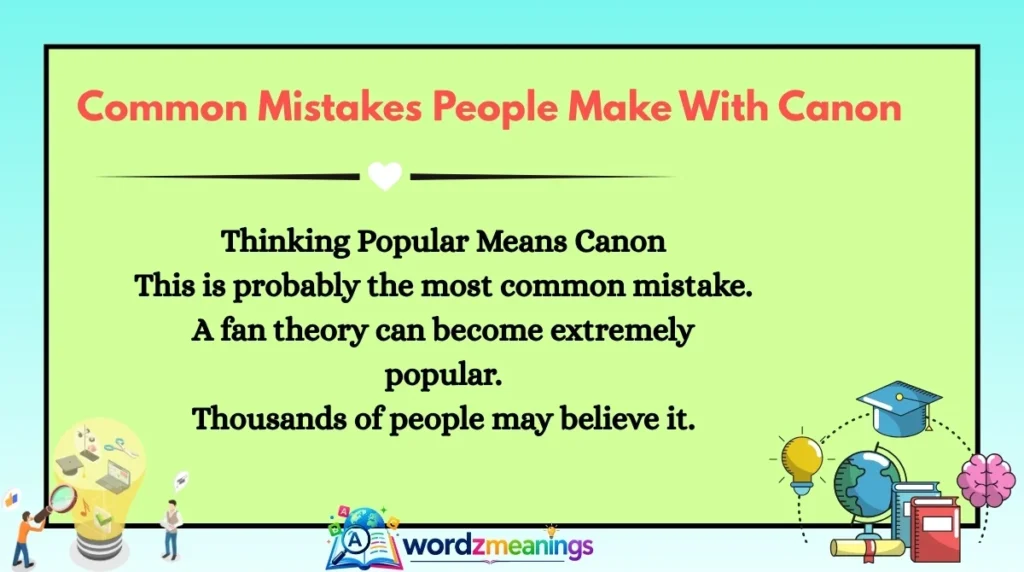
Thinking Popular Means Canon
This is probably the most common mistake.
A fan theory can become extremely popular.
Thousands of people may believe it.
That still doesn’t automatically make it canon.
Remember:
Popular ≠ Official
Confusing Headcanon With Canon
Your personal interpretation is not automatically official.
You might strongly believe:
“This character secretly likes another character.”
That can be your headcanon.
But unless the story confirms it, calling it canon may be incorrect.
Assuming Every Official-Looking Source Is Canon
Sometimes spin-offs, adaptations, games, or promotional material have a complicated relationship with the main story.
Always consider:
- Who created it?
- Is it officially recognized?
- Which timeline does it belong to?
- Does the main story confirm it?
Different franchises can have different rules.
Using Canon to End Every Discussion
Some fans use canon as if it makes all personal opinions meaningless.
But canon and interpretation aren’t always the same.
For example, a story may canonically show that two characters are friends.
Fans can still have different opinions about:
- Their personalities
- Their motivations
- Their future
- Their emotional connection
Canon provides facts, but interpretation can still be personal.
Natural Examples of Canon in Conversations
Example 1: Relationship Discussion
Person A:
“Do you think Maya and Noah are dating?”
Person B:
“I don’t know, but nothing is canon yet.”
What it means:
Person B is saying the official story has not confirmed their relationship.
Example 2: Fan Theory
Person A:
“I think the villain survived.”
Person B:
“That’s a cool theory, but it’s not canon.”
What it means:
The idea may be interesting, but the official story hasn’t confirmed it.
Example 3: Social Media Joke
Friend:
“I accidentally liked a photo from 2018.”
You:
“Sorry, that’s a canon event now.”
What it means:
You’re joking that the embarrassing moment has officially become part of their life story.
Example 4: Gaming Conversation
Player 1:
“Which ending is the real one?”
Player 2:
“The sequel confirms the first ending is canon.”
What it means:
The developers officially continued the story from the first ending.
Example 5: Personal Canon
Person:
“I once fell off the stage during a school performance.”
Friend:
“That definitely belongs in your personal canon.”
What it means:
The event was memorable enough to jokingly become part of their personal life story.
How to Reply When Someone Says “It’s Canon”
Your reply depends on the conversation.
If you agree:
“Exactly!”
“Finally, it’s confirmed.”
“I knew it!”
“The evidence was there.”
If you’re surprised:
“Wait, that’s actually canon?”
“I didn’t know that was officially confirmed.”
“No way. When did that happen?”
If you’re joking:
“Adding it to the timeline.”
“Officially part of the lore now.”
“Personal canon unlocked.”
“Unfortunately, we can’t delete it now.”
Related Slang and Fandom Terms
Understanding canon meaning slang becomes easier when you know similar internet terms.
Headcanon
A personal belief about a fictional character or story.
“My headcanon is that he hates mornings.”
Fanon
A fan-created idea widely accepted by a fandom.
“Everyone believes it, but technically it’s fanon.”
Ship
A relationship that fans support.
“I ship those two characters.”
OTP
OTP means One True Pairing.
It refers to someone’s favorite fictional couple.
“They are my OTP.”
AU
AU means Alternate Universe.
It places characters into a different setting or timeline.
“I love this coffee shop AU.”
Lore
Background information about a fictional world.
“The game’s lore is incredibly deep.”
Retcon
A change to previously established story information.
“The new episode completely retconned that detail.”
Canon Meaning Slang: Quick Comparison Table
| Term | Simple Meaning | Official? |
|---|---|---|
| Canon | Official story truth | Yes |
| Headcanon | Personal fan belief | No |
| Fanon | Popular fan belief | No |
| Non-canon | Outside official story | No |
| AU | Alternative universe | Usually no |
| Lore | Story background and world information | Can be |
| Retcon | Later change to story information | Can become canon |
| Ship | Relationship fans support | Not necessarily |
Frequently Asked Questions
What does canon mean in simple words?
Canon means officially accepted as true within a fictional story or universe.
What does “that’s canon” mean?
It means:
“That officially happened in the story.”
What does “not canon” mean?
It means something is not officially confirmed as part of the original story.
What is the opposite of canon?
Depending on the context, the opposite can be:
- Non-canon
- Headcanon
- Fanon
The closest direct opposite is usually non-canon.
What does canon mean on TikTok?
On TikTok, canon can refer to official fictional events, but it is also used jokingly about real life.
People may say:
“That’s a canon event.”
This often means an important, memorable, or unavoidable experience that helps someone grow.
What is a canon event in slang?
A canon event is an experience considered important to someone’s personal development.
Online, people often jokingly say someone must experience a mistake because:
“It’s their canon event.”
Is headcanon real canon?
No.
Headcanon is a personal fan interpretation.
Canon is officially confirmed information.
Can fan theories become canon?
Yes.
A fan theory can later become canon if the official creators confirm it in the story.
Until then, it remains only a theory.
What does “make it canon” mean?
It means:
“Make this officially part of the story.”
Fans often say this about relationships, theories, or character developments.
What does “personal canon” mean?
Personal canon is a humorous internet expression.
It means memorable events that someone treats as official chapters of their own life story.
Conclusion
The modern canon meaning slang is simple once you understand the main idea: canon means officially true or accepted within a story, fictional universe, or established timeline.
Online, the word has grown beyond fandoms. On TikTok, Discord, Instagram, gaming communities, and meme culture, people now jokingly use canon to describe their own lives too.
If something is canon, it’s official. If it’s headcanon, it’s someone’s personal idea. If it’s fanon, the fandom loves the idea but it isn’t necessarily confirmed.
The easiest way to remember it is:
Canon = officially happened.
And when someone says something embarrassing is now “part of their canon,” they’re simply joking that the moment has become an unforgettable chapter in their personal story.

I am Brandon Ellis, a language enthusiast and content writer at WordzMeanings. I create clear, accurate, and easy-to-understand explanations of words, phrases, and expressions to help readers improve their English every day.

9 thoughts on “Canon Meaning Slang: What Does “Canon” Mean? Updated 2026”